'I Was Wrong': Williams Apologizes to Utah as Arkansas' Offense Comes Apart
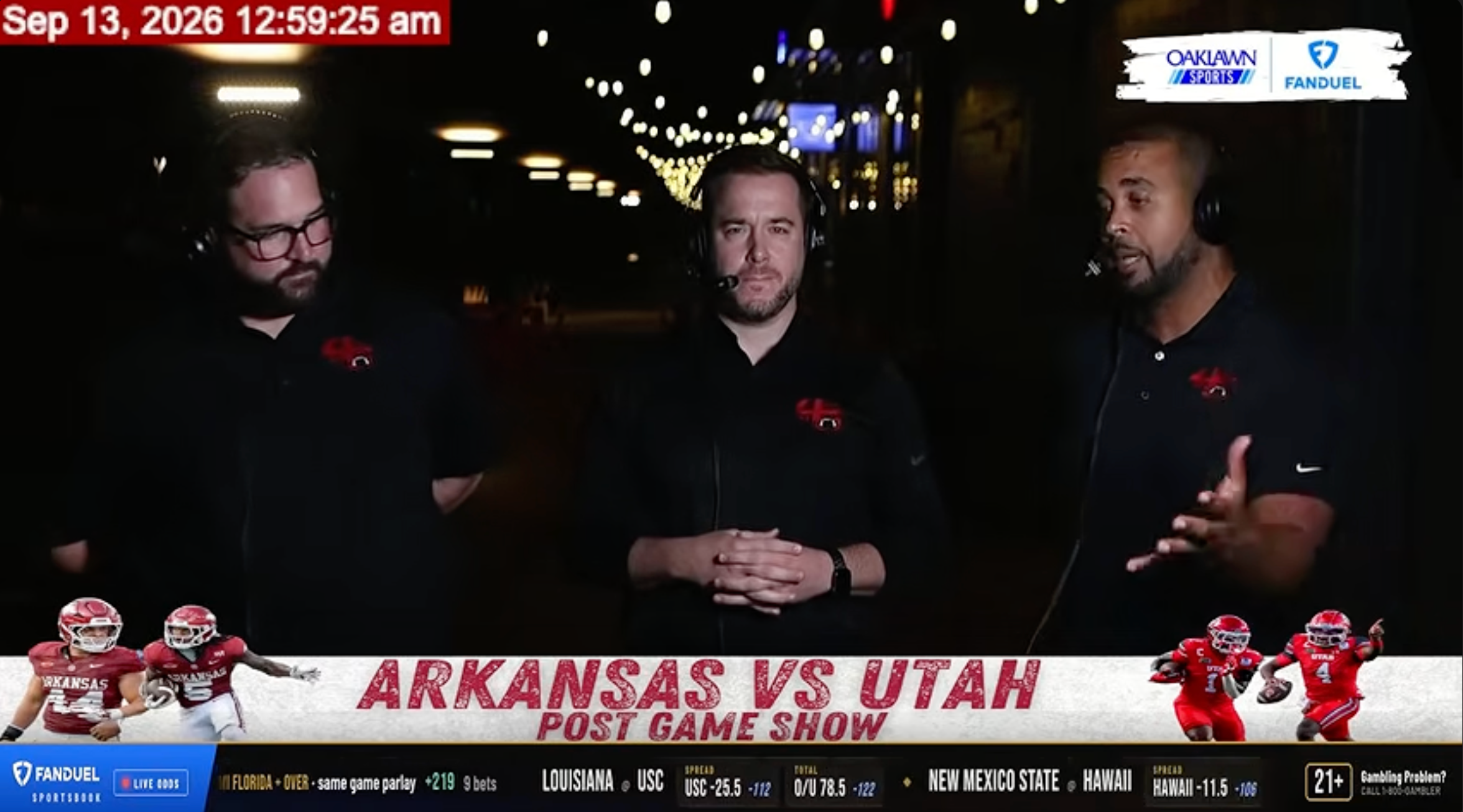
Arkansas lost 43-10 at No. 20 Utah on Saturday night, and when 4th & Five came on the air past 1:30 a.m. after the latest-starting game in program history, the first order of business was not a scheme critique. It was an apology.
The Apology Came Before the Autopsy
DJ Williams spent the week talking confidently about a Utah team he had studied on tape. By the end of the night, he was addressing Utah fans directly.
"I was talking very confidently this week because I didn't put enough respect on your program and I apologize," Williams said. "I was wrong."
He went further, crediting the trash talk that had found its way into the show's comment section all week.
"The trash talk was real and y'all owned it," Williams said. "Y'all were right. Your team is a really good football team and we respect good football teams."
Williams also admitted something he said he almost never does on this show.
"I did something that I never do this week. I let my emotions get involved," he said, adding that he still believes the Utah defense offered opportunities on film. "I just didn't know we were that bad offensively."
Utah has been a difficult place to visit for a decade. Since the College Football Playoff began in 2014, the Utes are 57-17 at home, the 12th most home wins among power conference programs and Notre Dame in that span. Arkansas fell to 1-1. Utah moved to 2-0.
"What Is Our Identity?"
Josh Throne kept coming back to one word, and it was the same word he said the staff sold all offseason.
"They've preached to us all offseason that their identity is run first, establish the run, they're going to play hard-nosed football," Throne said. "Well, they're not running first. First downs, we're not running first."
Instead, Throne said, Arkansas leaned on downfield shots and screens behind the line of scrimmage until the whole thing became predictable.
"There were so many wasted plays, fellas," he said. "So many wasted plays."
Grant Cook, who has made establishing the run a weekly talking point, conceded the point with a joke that was not really a joke.
"I am going to have to come up with a different tagline talking about establishing the run and what I want to see happen, because obviously we've abandoned the run," Cook said.
Cook allowed that the early run attempts got stifled and that the staff may have felt it could not keep spending downs there. His issue was with the alternative.
"I don't think that it's throwing the ball downfield for 50/50 balls with wide receivers that haven't created separation," he said. "I don't know that that's what we want to do either."
The middle of the field, Cook noted, was the one place Arkansas found anything. "That's where you did see the success," he said.
Watch: the full 4th & Five breakdown.
The Play Calling Points Straight at Cramsey
Offensive coordinator Tim Cramsey, who ran Ryan Silverfield's offense for four seasons at Memphis, was the name that surfaced most often once the show got into specifics.
Williams described a sequence that repeated itself for three or four drives.
"We would always throw on first down and then decide to run on second down, and now you're in situations where it's second and 10," Williams said. That math, he said, produced long third downs Arkansas could not convert, and the attempts to convert them rarely went over the middle.
What frustrated him most was the lack of adjustment.
"You have to realize very quick as an offensive coordinator what is working and what is not working," Williams said. "And he was just stuck to it, and it really put Arkansas in a bad spot."
Williams said Utah brought pressure and Arkansas largely picked it up, which only sharpened the complaint. "They're going to give you opportunities, and Arkansas did nothing with them at all," he said.
The early script was not the problem. Arkansas moved the ball on the opening drive, settled for a field goal, then forced a turnover when Quincy Rhodes Jr. hit Utah quarterback Devon Dampier as he threw and Christian Harrison came down with Arkansas' first interception of the season. Wayshawn Parker's one-yard touchdown run put Utah in front 7-3, and the game got away in the second quarter.
"We were feeling pretty good when it first started. The first drive looked really nice," Cook said. "Hated that we stalled out. We create a turnover shortly thereafter, and then the wheels fell off."
Williams pointed to a blocking penalty on receiver Chris Marshall that, by his description, backed Arkansas into a first and 25 at the worst possible moment. He said he considered it a clean block under the old rules and a casualty of the new ones.
A Quarterback Room Without an Answer
KJ Jackson started fast, completing eight of his first 12 attempts for 72 yards. He then connected on six of his next 22 and threw an interception.
"KJ did not look good. He didn't look good last week," Williams said, adding that the backup quarterback who entered late did not change his read of the position. At one point during the broadcast, Williams said, the crew looked at each other with the same question: "Who the hell are they throwing to?"
Throne was not willing to hang it all on the starter.
"I don't think it's all on him, honestly," Throne said. "I think that he was put in a lot of bad situations and wasn't really offered a lot of help from some of his teammates at times."
Throne also cautioned against reading much into the late fourth quarter drive from the backup. "I'm not going to call a fourth quarter drive this prolific performance when you're playing against a lot of backups," he said.
Running back was the one spot the hosts defended. When Braylen Russell and the backs had a lane, Cook said, they produced. The receivers did not get the same grace, with Cook pointing to drops and one-handed attempts on balls that needed two.
The Halftime That Never Landed
Williams framed the second half as a referendum on the head coach. Arkansas did not answer it.
"This is where Ryan Silverfield shows his value as a coach," Williams said. "What are you going to say to your guys at halftime to have them come out and now put a better product on the field? It didn't seem like that happened."
Throne said the sideline shots stuck with him.
"I saw a lot of just standing there looking tired and defeated," Throne said. "And that's not the identity that I thought we were going to get with this coaching staff."
Williams was careful to separate the offseason from the product. Silverfield, hired as the 35th head coach in program history after going 50-25 at Memphis with bowl eligibility in all six of his seasons there, said the right things from January to August, Williams argued.
"There's been no negative on my end as far as what he's been able to say and how he's led during the offseason," Williams said. "But at the end of the day, it comes down to what ends up going out on that field on Saturdays, and what's showed up the past two Saturdays has unfortunately been pathetic for the Arkansas Razorbacks."
Throne's frustration is rooted in the roster, not the talent level. He said the show had already walked through the position groups and agreed several had improved on paper.
"I honestly think that there's talent out there to do way better," Throne said. "That's why you guys have heard me kind of speak harshly about the coaching in this situation."
Millions Spent, Ten Points Scored
A viewer question about Arkansas' athletic funding model pushed the conversation into money, and Williams did not soften it.
"If you spent all of these millions of dollars to put up three points through four quarters," Williams said, "we've got some serious issues."
He said the disconnect between the opportunity and the output is what bothers him most. "It honestly pisses me off, and it just makes me hate the status of college football," he said.
Cook's fix was blunt.
"You can't pay for play, because it's not pay for play. It's name, image and likeness," Cook said. "I think we need some pay for play. If you don't play, you don't get paid."
Both Cook and Throne endorsed performance-based contracts on air. "You don't produce, you don't get a check," was how the idea landed.
The Number Nobody Wanted to Say
Two weeks of tape from around the country left Williams willing to put a hard projection in the room.
"There's a potential, fellas, that we have one win this year," he said. Cook and Throne both agreed it was on the table.
Throne pushed back on his own pessimism just enough to note that teams improve in season. Then he restated the stakes.
"This was supposed to be take a step forward," he said. "This is a big step backwards for Arkansas."
Georgia Next, and Not Much Time
Georgia comes to Fayetteville next, and Cook was realistic about what three days of practice can fix.
"We do have to figure out how to run the ball. Where we can't run the ball, we're going to be one dimensional and people are going to tee off on us," Cook said. He described a Georgia front loaded with linemen he called bigger and stronger than he ever was, adding they intend to run it down Arkansas' throat.
Asked what happens if the pad level issues up front do not get cleaned up, Cook did not blink.
"How am I supposed to expect that it's just magically going to appear as we play Georgia?" he said.
The show's week is already mapped: a full game breakdown Monday, Cook's offensive line film review Tuesday and Throne's scouting report on Georgia's front. Williams said the goal is to trade reaction for evidence.
"Instead of just saying this guy's awful, this was awful, we're going to find the ways to explain to y'all and show y'all and learn ourself why it's bad and what the solution is," he said.
Williams set the bar for Saturday where the hosts have set it all night, and it has nothing to do with the scoreboard: play the game the right way, and look like it matters. Georgia will supply the rest of the answers.