The Film Was Worse Than the Score: DJ Williams Breaks Down Arkansas' Opener
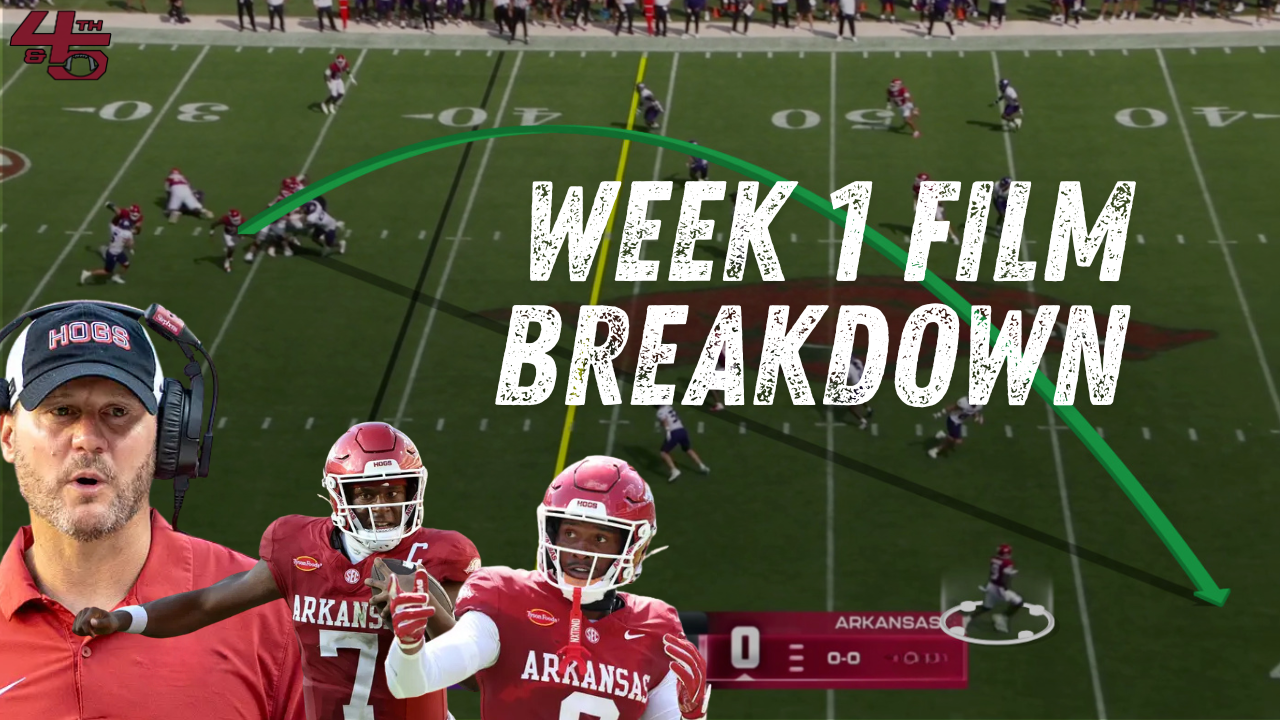
Arkansas won the opener by 17 points. The tape did not feel like a 17 point win, and DJ Williams did not pretend otherwise when he sat down to watch it again.
The Razorbacks beat North Alabama 31-14 on Sept. 5 at Reynolds Razorback Stadium on the hottest recorded game day in Arkansas football history, with the temperature hitting 101 degrees at kickoff.
Williams, the former Razorback tight end and NFL veteran who hosts 4th & Five, went back through the offensive film in a night edition of his breakdown. He came out of it less encouraged than he expected to be.
"It is extremely difficult film to watch," Williams said.
That runs counter to how these reviews usually go, he explained. Second viewings normally soften the sting.
"When you usually watch a game, we usually like to go back and watch the film," Williams said. "And usually watching the film makes us feel better about everything that happened. Not the case with this film."
The easy ones have to be easy
KJ Jackson threw three touchdown passes, including a 2-yard score to tight end Matt Adcock and a 10-yard strike to Jaden Platt that pushed Arkansas to a 21-0 lead. The final numbers were fine. The process, on film, was not.
Williams flagged a pattern in the first half: layups left on the field.
"When the easy throws are there, you have to make them," Williams said. "There is no margin for error when it comes to the easy ones."
He pointed to a quick out route to the flat on a third down that hit the dirt, the kind of throw he described as about as simple as it gets in college football. He also flagged a first-drive third-down attempt that should have been intercepted and was only dropped by the defender.
The bigger concern for Williams was not the ball placement. It was the eyes.
On multiple snaps, he said, Jackson locked onto his first read, decided it was covered, and abandoned the pocket rather than working to a second or third option. On one of those plays, Williams noted, a receiver came free behind the entire secondary on what looked like a coverage bust, and Arkansas never saw it because the quarterback had already tucked and run.
"You can't do that as a quarterback, especially when the pocket is clean," Williams said.
He was blunt about the interception before halftime, when Jackson was picked in the end zone with 19 seconds left in the second quarter. On the replay, Williams said, Jackson snapped his eyes to his target immediately and never accounted for the middle of the field.
"I don't think KJ ever saw this guy ever," Williams said. "He never locates the middle field safety."
Williams' fix is not complicated: trust the receivers to win, and use the drop to read the secondary. "I trust my receivers to hold it down," he said. "I don't have to stare them down the whole way."
What Williams did note as a positive is how Jackson has taken the correction. Describing head coach Ryan Silverfield's press conference and his own read of the week, Williams said Jackson has been coached hard and answered it the right way. Silverfield, he added, was direct about how difficult the film was.
Silverfield has already been asked publicly whether he considered a series for Memphis transfer AJ Hill. Williams did not want the breakdown to turn into a depth chart argument.
"There is a position battle. There's always a position battle. Doesn't matter who you are," Williams said. "I don't want this breakdown to be about that."
Watch: the full 4th & Five breakdown.
Up front, the issue was physicality before scheme
Williams kept his line critique at the unit level and pointed viewers toward co-host Grant Cook's dedicated offensive line breakdown, which digs into technique, scheme and pad level.
Still, the theme was hard to miss. Williams described a group that came off the ball slowly in stretches, played high, and lost the initial collision more than an SEC front line should against a visiting opponent.
"Maybe it was just an off day for the offensive line, but the physicality is kind of the part that is very disappointing," Williams said.
He also found finishing issues that surprised him. On more than one snap, he said, a lineman was in good position and simply stopped working before the whistle. On another, a lineman got downfield on a screen with a chance to make a play and reached out and grabbed instead, wiping out the gain.
"If any position group knows the impact of holding, it's your offensive linemen," Williams said.
Williams was careful to show the other side of it, too. He stopped on one rushing snap with a clean double team and a clean second-level block and left it up on the screen.
"That's how it's supposed to look," he said. The problem, in his view, is consistency, not capability.
The challenge to Chris Marshall
The longest single stretch of the breakdown was reserved for Chris Marshall, and Williams framed it as a challenge rather than a criticism.
He spent several clips praising the Boise State transfer: hands away from the body, acceleration off the line, a third-and-10 route where Marshall set up the defender outside before working back underneath, and a habit of refusing to go down on first contact.
"When he steps on the football field, he's arguably the most talented person on the field," Williams said. "No matter who we play, I believe in him that much."
Then he pulled up the run snaps.
Williams showed a series of plays where Marshall did not attack his assignment in the run game, including one where the receiver was tasked with the most dangerous man on the perimeter and took a path that never put a hat on the defender.
He also flagged a fourth-quarter clip where Jackson checked at the line and Marshall's body language changed once he realized the ball was not coming his way.
Williams reached back to the receivers he played with to make the point, naming Greg Childs, Joe Adams, Jarius Wright and Cobi Hamilton as the standard, guys who chased backside blocks so a Knile Davis or Dennis Johnson run that broke one tackle turned into a touchdown.
"Just imagine if this running back sneaks through, who ends up making the tackle?" Williams said of one clip. "The guy that Chris Marshall is supposed to block."
He extended the note to the receiver room broadly, including a screen play where he wanted CJ Brown selling a route at full speed instead of at partial effort. And he tied it to the next level.
"At the NFL, if you're not a willing blocker, there's no place for you on the football field," Williams said. "Doesn't matter how great you can catch a football."
The tight ends came out of it clean
The one group Williams left the film feeling good about was the tight ends, and less for the catches than for the dirty work.
Platt caught a 10-yard touchdown and Adcock scored from 2 yards out, but Williams was more taken with the blocking, particularly from Ty Lockwood.
He highlighted Lockwood on a goal line snap, coming off the ball and displacing the defender, and on a downfield block on a well-schemed third-down conversion.
"Lockwood had an exceptional day blocking," Williams said. "That dude's earning some more playing time."
Williams wants both tight ends more involved as targets, and he pointed to a play design where Lockwood slipped in behind the linebackers untouched. The ball came out late, he said, and turned an open window into a contested catch.
He also singled out a young Arkansas receiver for something small that jumped off the tape. With Jackson scrambling, the receiver pushed up the field, then snapped his route off and turned back for the ball on his back hip, the exact scramble drill Williams said he ran in Green Bay.
"That may be my favorite moment of this film right here," Williams said. "There's no reason he would know to do this unless he's been coached to do it."
Questions the staff still has to answer
Williams was open about the things he could not explain from one viewing, and he did not force a conclusion on any of them.
- The blocking technique on Arkansas' RPO snaps, where a lineman popped up and hesitated rather than driving off the ball. "I'm not too familiar with the offense or the scheme or the technique," Williams said, "but I just know when we start playing against some dudes, if you come off the ball like that, they're going to cave your chest in."
- A snap where Jaden Platt pass set instead of releasing into the crossing route behind a dig, leaving the middle of the field without an underneath option. Williams' guess is that Arkansas was baiting a hug rusher into blitzing, but he flagged that Jackson never looked that direction.
- A pre-snap RPO look that appeared to hand Arkansas a clean throw to the perimeter that never came. "Very bizarre film to watch," Williams said.
His working theory on some of it is simple: this was game one against a visiting opponent, with Utah and Georgia on the calendar.
"I don't think we want to come out and put the whole playbook out for full display against a team like North Alabama," Williams said. "I think you save a little bit for Utah and Georgia."
What it means heading to Salt Lake City
The betting market has already reacted. Appearing on the show, Oaklawn Sports vice president of racing and wagering Zack Gillham said Utah had moved to a 13.5 point favorite over Arkansas, after sitting around 9.5 and climbing through 10.5 and 11.5. He also had the money line at Utah minus 550 and Arkansas plus 400, with a total of 56.5.
Williams did not argue with the direction of the move.
Arkansas travels to No. 21 Utah on Sept. 12, then opens SEC play at home against No. 3 Georgia on Sept. 19. The 4th & Five week ahead includes Cook's offensive line film review, a defensive breakdown from Matt Harris, a look at Utah's defensive front from Big Z, and a full opponent scout from Josh Throne.
The good news for Arkansas is that most of what Williams flagged is correctable, and almost all of it showed up correctly at least once on the same tape. The question is whether it gets cleaned up in six days, because Salt Lake City will not drop the interception.