What Is a Year on the Bench Worth? 4th & Five on the Death of the Developmental Player
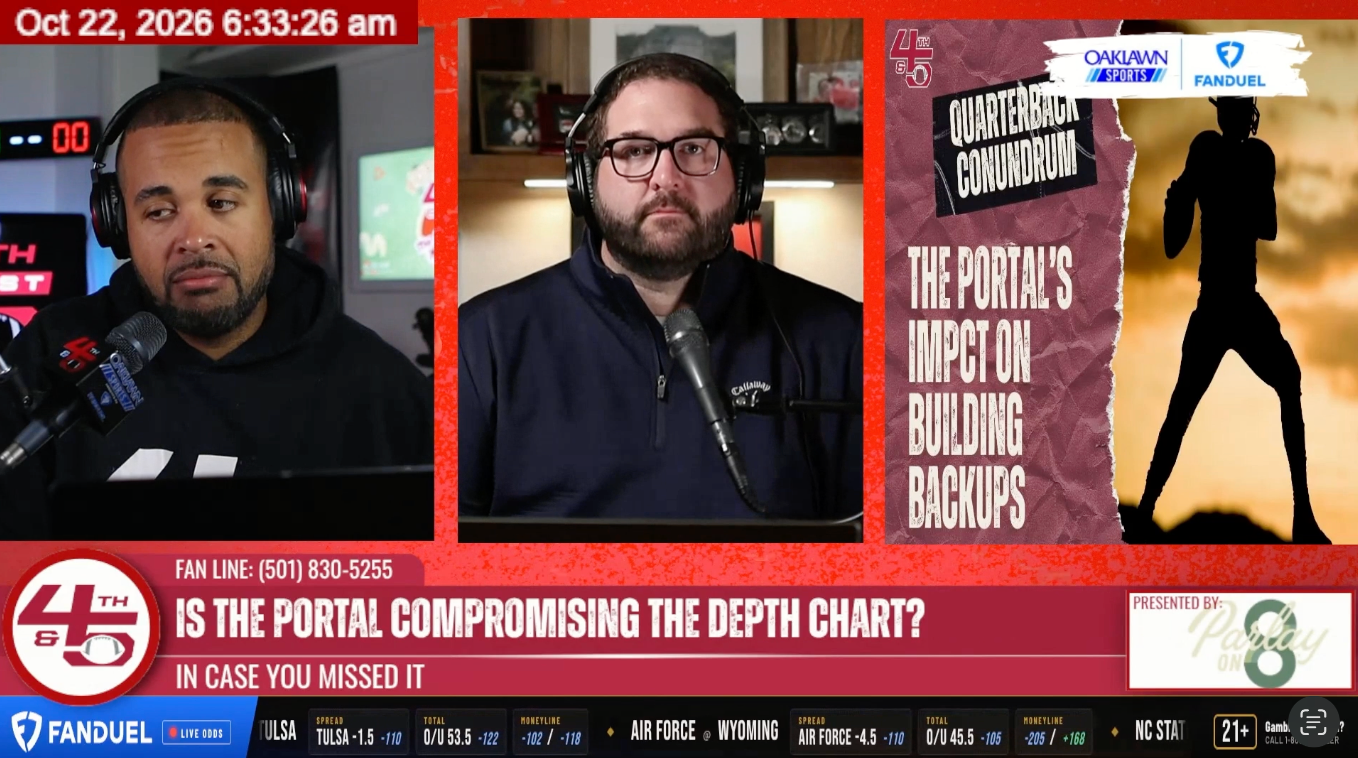
College football used to pay young players in patience. Sit a year, learn the offense, grow into the job. Now the sport pays in cash, and the bill for a player who is not going to play has gotten hard for anybody to stomach.
That was the question 4th & Five founder and host DJ Williams put on the table this week, and it was not really about quarterbacks alone. It was about whether the developmental player still exists at all.
"How much are y'all willing to pay somebody to not contribute to the football team maybe for two years?" Williams asked.
The redshirt year used to be free
Williams framed what the old model actually bought a program. A coach signed a young player he believed in, let him sit, and used the time to protect him.
"It used to be a good situation for coaches to get a young guy in who you know is going to be the future of your program," Williams said. "Develop these guys, let them get used to the landscape of college ball, used to the playbook, understand the offense, build chemistry."
There was a protective element to it, too. Williams noted that coaches have long worried about pushing a player onto the field before he is ready, because a bad early experience can get in a young player's head and stick.
None of that logic has changed. What changed is that the player now has a market, and the market does not reward waiting.
Two models, and neither one is clean
Williams laid out the choice for co-host and analyst Grant Cook as a pick-your-poison question.
Option one is the ideal: a really good young quarterback sits a year or two inside the same program he is eventually going to start for. Option two is the one Williams says a growing number of schools have quietly moved to.
- Carry a solid emergency backup, good enough to keep the offense upright if the starter goes down.
- Skip the multiyear development investment entirely.
- When you need a starter, go buy one who has already proven it at a lower level.
Cook put real numbers on the first model, even while calling them hypothetical.
"Funny money, don't know real numbers," Cook said. "They're really good, just not ready to play. You pay them 400 grand for their freshman year and 500. So you're in it for a million dollars and then they leave."
That is the part that makes athletic departments flinch. It is not just the cost of the wait. It is the cost of the wait with no guarantee the player is still on your roster when the wait ends.
Watch: the full 4th & Five breakdown.
The Group of Five route has a hit rate problem
The second model has an obvious appeal. Somebody else pays for the development years, and you buy the finished product.
Cook's hesitation was about accuracy, not philosophy.
"You have to hit on them," Cook said, adding that he could think of maybe one or two clear examples of a program nailing that swing.
Williams brought up Trinidad Chambliss, who went from Division II Ferris State to Ole Miss. Williams guessed Division III on the fly; Cook corrected him to Division II. Cook also pointed to Darian Mensah, who moved from Tulane to Duke, and noted that Mensah followed a coach he already knew, which Cook said makes that kind of transition easier to pull off.
Beyond that, the list ran thin. The hosts walked through the names that get cited as proof the model works: Dillon Gabriel, who started at UCF. Diego Pavia, who started at New Mexico State. Joey Aguilar, who went from Appalachian State to UCLA to Tennessee. Jayden Maiava, from UNLV to USC. Max Brosmer, from New Hampshire to Minnesota. Taylen Green, who arrived in Fayetteville from Boise State.
Cook's read was that the list is short on purpose.
"That's a list of seven, eight players that are the elite ones," Cook said. "There's 130-something teams between Group of Four and Group of Five."
The math is the whole argument. Cook corrected the alphabet soup mid-sentence to Power Four and Group of Five, but the point survived the correction. More than 130 FBS programs are producing candidates, and the hosts could confidently name a handful who became genuine answers at the next level.
The Arkansas thought experiment: Mallett and Mustain
To make the cost real, Williams reached for two of the most recognizable quarterback recruits in modern Arkansas history.
First, Ryan Mallett, the Texarkana, Texas, product in the 2007 class who signed with Michigan out of high school, transferred to Arkansas and started for the Razorbacks in 2009 and 2010 before being drafted by New England.
Williams asked the audience to strip away everything that came later. Not what Mallett became. Just what a program knew about him the day he picked a school.
"If he decided to commit to the University of Arkansas knowing he was going to sit his first year, how much do y'all think y'all would be willing to pay a quarterback like Ryan Mallett?" Williams asked.
Williams acknowledged the obvious objection before anyone could raise it: plenty of people believe Mallett would have pushed Casey Dick for the job immediately. The hypothetical only works if you force him to wait.
Then Williams raised the stakes with Mitch Mustain.
Worth stating plainly, because the history matters: Mustain, the Springdale, Arkansas, product and a national high school player of the year honoree in the 2006 class, did not sit. He started games for the Razorbacks as a true freshman before transferring to USC. The segment used him strictly as a what-if.
Williams' argument was that at the moment of signing, Mustain was the more expensive player.
"I honestly do believe his number should be higher than Mallett at the time," Williams said, noting that Mustain, like Mallett, could have gone anywhere in the country.
Cook agreed with the hierarchy. He compared Mustain's high school standing to that of Bryce Underwood, the No. 1 overall quarterback recruit in the 2025 class who flipped to Michigan, and slotted Mallett a tier below as a sit-one-year-then-start investment.
What it actually means for roster building
The conversation never landed on a verdict, and that is the honest place for it to sit.
Model one asks a program to spend significant money on a player who will not help it win for a season or two, with no contractual certainty he stays. Model two asks a program to be right about an outside evaluation, repeatedly, with a documented hit rate that the hosts themselves could count on one hand.
What is no longer debatable is that the free version is gone. A developmental year is now a line item, and the player sitting through it has a standing offer somewhere else to play immediately.
Watch how Arkansas stacks its quarterback room behind the starter, because that depth chart is a budget document now, and it will tell you which model the Hogs believe in.