What Arkansas Has Left To Play For, And Why Development Costs More Than Ever
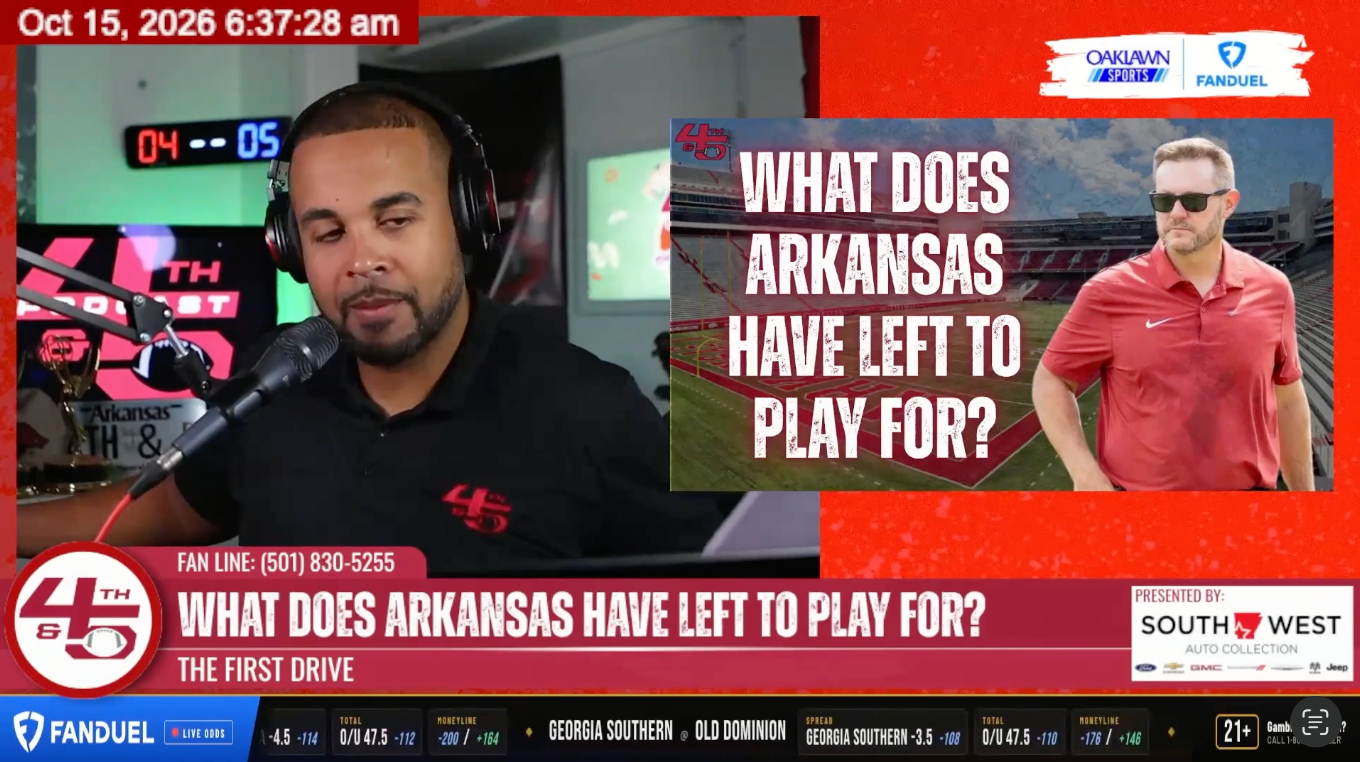
DJ Williams opened the segment with a question Arkansas fans have been circling for weeks: what is actually left to play for? His own answer was short. A lot. Getting to why took the rest of the show.
The conversation started where most of these do, with the scoreboard, and ended somewhere far more uncomfortable: what it costs a program like Arkansas to develop a football player in 2025, and whether anybody can afford to do it the old way anymore.
The Standard For A Successful Finish
Williams pressed co-host and analyst Grant Cook on what would make the back half of the season a success, knowing most people outside the building are not projecting a pile of wins.
Cook did not throw out the record entirely.
"I mean, that's still on the table. So technically, you're still playing for that," Cook said of a bowl berth, before adding the honest part. "It's tough to find them on the schedule. I'm not going to lie about that."
Beyond that, his list was culture, pride and tape.
"You're still in a culture establishment period," Cook said. "And then all these players still have pride to put things on tape. And if they aren't going to be at Arkansas next year, well, they need to put good tape out there."
A viewer named John echoed the same idea in the chat, writing that at this point the Hogs are playing for recruiting and momentum into next season.
Development Used To Be The Whole Point
Williams framed the old model plainly. A rough second half used to be an opportunity.
"We need to get guys in there that are going to be the future of this program, get some game reps, let them know what it feels like," Williams said. "Put a lot on their plate, see how they handle adversity, so next year they have that experience."
His follow-up was the real question. Does a coach still put anything in that pot when he has no idea who will be on the roster in January?
"Well, I mean, I think you have to," Cook said.
Cook pointed to bowl practice as the clearest example of what the sport has lost. For a staff, December used to be a second offseason.
"Going to a bowl game was a huge thing for the coaching staff, because it gave you essentially almost like another mini spring for younger guys to get a lot of reps," Cook said.
Watch: the full 4th & Five breakdown.
Do Coaches Even Have Time To Coach?
That led Williams to the point he kept coming back to. Developing players is supposed to be the defining trait of a good coach. The current calendar may not allow for it.
"We all the time talk about, is it the players or is it the coaches not being able to coach these guys up to do it the right way," Williams said, referencing an earlier debate with co-founder and co-host Josh Throne about where accountability lands when things go wrong.
Then he turned the question around.
"Do these coaches actually have time to coach?" Williams said. "Because the idea of bringing a guy in and turning around bad habits, coaching him up and getting it all done in a couple months in the offseason, it's not really realistic."
Cook agreed, and zeroed in on the type of player who gets squeezed hardest: the raw, high-ceiling kid who is nowhere near ready to play against grown men.
Cook's Hypothetical: Paying To Develop Someone Else's Starter
To illustrate it, Cook walked through a scenario he invented on the spot. To be clear, this is not a real Arkansas contract and not a real player. It is a made-up example built to show the math.
Start with a high school offensive lineman who is going to be a very good college player eventually, but is not ready as a freshman. Say the market on him is half a million dollars. Arkansas goes a little higher to win him, redshirts him, and he does not take a snap.
Year two, he is closer, but there is still a guy you would rather play. And now you have to raise his number so he does not leave.
Year three, by Cook's telling, he is finally physically ready, finally knows the offense, finally has the maturity to go play winning football.
"And somebody plucks him," Cook said. "He goes to Texas, LSU, Ole Miss, wherever in the world. And now he's playing against you."
Again, those numbers are Cook's illustration, not reporting on any actual deal. The point underneath them is the one that matters.
The Question Williams Put To The Audience
Williams took the hypothetical and handed it to the fan base directly.
"How much are y'all willing for this coaching staff and the general managers and the football administration to invest in a player that cannot immediately contribute to the team?" Williams asked.
He pointed out the obvious tension in recruiting-class chatter. Fans want four and five stars. Those players cost more, and most of them are not plug-and-play.
"There's only a handful of freshmen a year in the country that can come in and immediately contribute at a high level," Williams said, calling it his own read rather than a hard number. "The rest, it's just a development thing. And there's nothing wrong with that. That's just how you used to build programs."
His worry is what that does to in-state recruiting. If staffs lean on the portal to avoid paying for players who sit, Williams said, the next genuine gem in Arkansas may end up developing somewhere else.
A viewer named Jacoby raised Clemson's Dabo Swinney in the chat, arguing that a coach who resisted the portal has been forced into it. That is the viewer's read, not a reported fact, but it fit the theme of the hour.
Why Arkansas Has To Pay Up Front
Cook's sharpest structural point was about leverage. In his view, blue bloods can sell patience. Arkansas cannot.
"I think we're a school that has to pay them up front," Cook said. "I think there are schools out there that don't have to pay those guys right off the bat, and then you end up paying the ones you want to keep to stay because they want to be at the program."
He named Georgia and Ohio State as his examples of programs that can tell a recruit to prove it first, an assessment he offered as opinion rather than inside knowledge of either school's model.
"We've got to entice people to come here with the money," Cook said. "But then it's kind of like, if the money's not right, there's not really anything that's going to tie them back to us."
Does it sound fun? Williams asked whether it even sounds appealing to be a head coach right now. Cook laughed it off, then gave the answer of somebody who has sat in those rooms.
"There's a way to do it, and that's why they get paid millions of dollars to figure that stuff out," Cook said. "Wouldn't you love to try to piece that puzzle together, though? I think it's still possible."
Finishing With Something To Build On
Williams asked how much it matters for head coach Ryan Silverfield to close the season with momentum. Cook did not hesitate.
"Anytime you have some momentum going into the offseason, that's something to build off of," Cook said. "I mean, it's massive."
He reached back to his own time on campus for the comparison, recalling a Bobby Petrino era season that ended without a bowl trip but finished with a win over LSU on a last-second catch in the corner of the end zone. That is Cook's recollection as he told it on the show.
"You ended the season on a high note and went into the offseason, which was brutal," Cook said. "But you at least knew, OK, at the end of the year, we were going like this, not like this."
Williams did mention that people he has talked to inside the program feel good about their recruiting targets and expect a very different roster next year, though he hedged it himself, saying he does not know whether Arkansas is truly in that position yet.
So the thing to watch over the final weeks is not the record. It is whether the Hogs look like a team building toward something, because in the current sport, tape and momentum are the only recruiting pitches that cannot be outbid.