Arkansas' Line Finally Moved People. Now Cook Wants It To Travel.
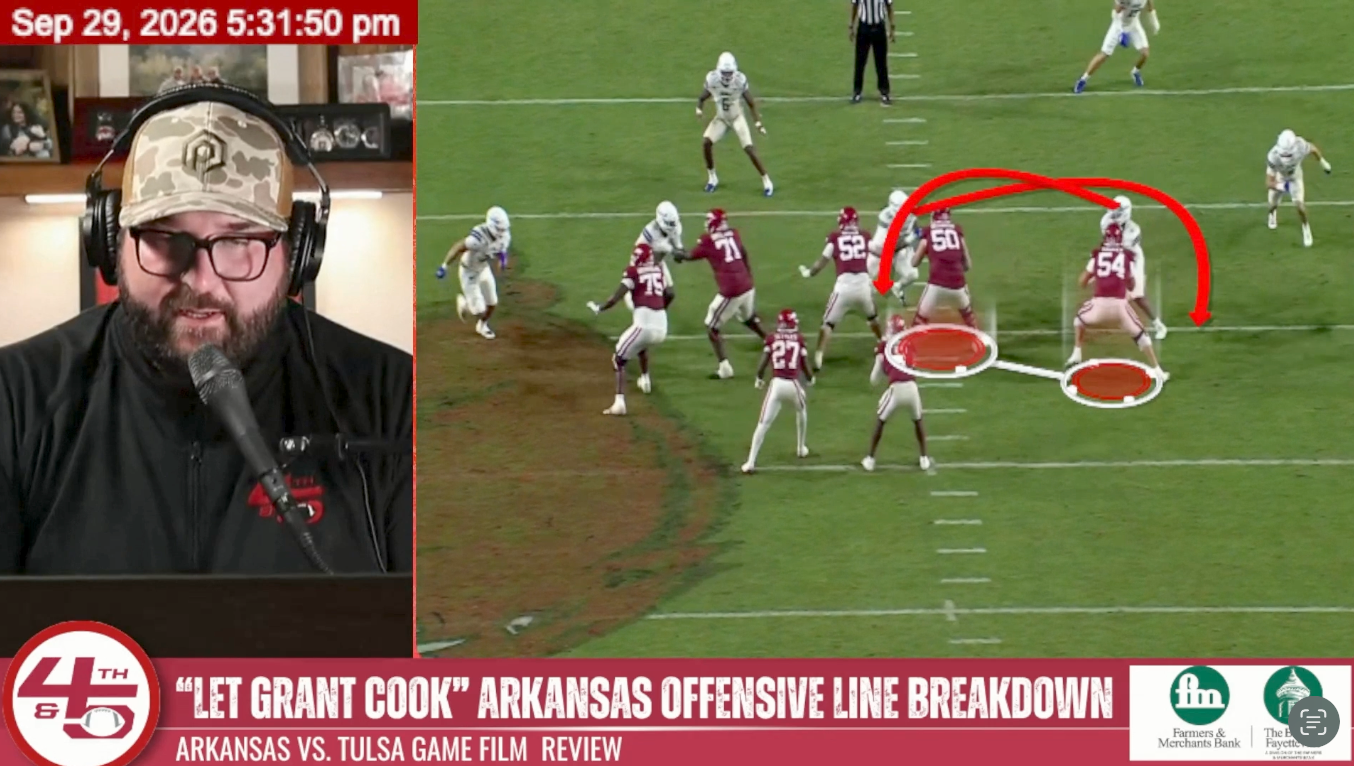
Arkansas won 34-6 over Tulsa on Saturday at Donald W. Reynolds Razorback Stadium and snapped a losing streak against FBS opponents that had stretched across a full calendar year. The more useful question buried inside the win: did the offensive line actually change, or did Tulsa just let it look that way?
On the latest edition of "Let Grant Cook," the 4th & Five film segment, Cook and host DJ Williams put the Razorback front five on tape and landed on the same answer. Progress, yes. Finished product, no.
"All in all, I think we took a step forward against Tulsa," Cook said.
The caveat came first, and it came from both of them. Arkansas is 2-2 and 0-1 in the SEC under first-year head coach Ryan Silverfield, and the schedule does not care about a 28-point win over a Group of Five opponent.
"The difference between Tulsa and the rest of the SEC, there is a big difference, especially when it comes to personnel," Williams said.
Butts Together, Red Line Behind Them
What got Cook out of his chair was not a highlight. It was a third-down conversion where two double teams showed up on the same snap and the pile actually went somewhere.
Cook put his fists together to explain it. Hips tight, shoulders square, two bodies moving one defender backward instead of two bodies leaning on him.
"We got butts together. We're driving people, man," Cook said. "We're trying to reestablish that the red line right here is where the ball was snapped from. We're down the field, gentlemen. Come on now. We are down the field."
He flagged the same thing at left tackle, where Kavion Broussard came off the ball with pad level and finished the block. At center, Cook liked the effort from Caden Kitler even on a rep where Kitler got stalemated and driven back, because Kitler did not quit on it.
Then came the part Cook would not let slide.
"We are straightlegged," he said. "I don't love that."
Watch: the full 4th & Five breakdown.
The Group Still Has No Edge
The mentality thread ran through the whole segment, and it started on a screen. Cook praised Kitler for sticking his off hand at the snap and praised the interior for working flat down the line to get in front of the ball.
Williams wanted more than an angle. He wanted a collision.
"We've got to go find color. We got to hit somebody," Williams said. "This is opportunity for the big man to get out in space and make these guys feel the pain. And that's the stuff you feel in the fourth quarter."
He was blunt about what he is not seeing from the group, and he admitted he has been watching Kitler closely because Arkansas needs him.
"I see moments like that where I just don't see a lot of physicality and aggression of like, oh, that dude's a rattlesnake. Keep your head on a swivel around him," Williams said.
Cook did not talk him out of it. He widened it.
"I think maybe I see it across the entire offensive line, that they don't have that mentality of the kind of down and dirty dudes that are always a pest," Cook said.
Cook framed it as strategy, not attitude for its own sake. Hit a linebacker twice on a flare pass and the third time he arrives late, looking sideways.
"They don't run over there near as fast," Cook said. "They're like, am I about to just get whacked over here?"
Something Changed In The Meeting Room
Williams asked the obvious follow-up. If this is what the double teams are supposed to look like, where was it for three and a half weeks?
Cook's read is that the approach itself was different against Tulsa. Neither host claimed to know who made the call, and the Arkansas line is coached by Marcus Johnson and Jeff Myers.
"I think it almost had to have" changed, Cook said. "Before, it was we were just kind of putting our hands on people and we kind of shuffle our butt into the hole and just hope for the best. We're just hanging on to that block, which I say is the defensive lineman's dream."
The other tweak Cook spotted was on who climbs to the second level. Earlier in the season it looked predetermined, one lineman peeling off on schedule and leaving a teammate alone on a single block.
"It looked like this week they said, no, let's come together. We're going to push this to linebacker depth," Cook said. "If nobody declares, then that's fine. Stay on the down block."
That fix created a new problem on one rep, where Cook pointed out a clean double team from Kobe Branham and the right side that produced two or three yards of movement before both blockers left for the same linebacker at the same time.
"They jinxed on each other and they both split," Cook said. "We didn't have any communication on who was going to go up."
Asked how a coach teaches that feel, Cook said it is chemistry more than coaching points, and chemistry is the one thing a portal roster is short on.
"It's an art and a science," he said. "I don't know that you get that totally in the portal world anymore, because you really just get like a spring together."
The Draw That Sold Too Well
One rep left both hosts guessing, and they said so. Arkansas appeared to be in a big-on-big protection with running back Cam Settles responsible for the extra rusher, but the picture never resolved.
Settles released without looking for the ball. Kitler took off downfield. Quarterback Jackson, the one the hosts call KJ, barely escaped a well-timed Tulsa blitz.
"I thought it was a pass the whole way, and then at the tail end of that play I saw Caden Kitler start running downfield," Cook said. "That is very bizarre."
If it was a designed draw, Williams said, the sell was the problem.
"If that's how they're being taught to really sell that draw, we may want to tighten that up just a little bit, because he almost got sacked," Williams said. "I get on to them about not selling the screen game very well. They're selling that way too much."
Adam Hawkes Was The Payoff
The clips Cook was most excited about came from the second half, after Arkansas swapped Adam Hawkes in for Bryant Williams on the right side.
Cook had flagged Hawkes in the spring off a handful of practices and said the tape backed up the athleticism he remembered. Pad level. Hips rolling through contact. Feet that never stopped.
"Now we're like seven yards down the field," Cook said. "DJ, I don't remember the last time we pushed somebody seven yards down the field."
Cook was careful to show the low lights too. On one pass rep, Hawkes took a wide set against a defender who was not wide, opened an inside lane and gave up a quick inside move.
"We want to stay always shaded on that inside shoulder and take away that inside move. It's the quickest route to the quarterback," Cook said. "I can live with it because we got some other positive stuff."
Williams' read on the competition was about traits, not effort. He credited Bryant Williams' strength and grip, then said the right side has been losing on movement.
"We're just struggling with the athleticism part and being able to be in the right position," he said.
The Lineup Call Ahead Of Texas A&M
According to the hosts, the depth chart released after the Tulsa game still listed Bryant Williams as the starter. Both of them said they would go the other way.
"We're not trying to get anyone to lose their job here. We're just looking at the best 11 potential players to put on the field," Williams said. "Based off what we saw, it looks like Hawkes, in my opinion, should potentially get the start against Texas A&M."
Cook's answer was two words. "I agree."
Both hosts also acknowledged the obvious. A second half against Tulsa is not the same assignment as a Saturday night in the SEC, and Cook described the Aggie front as a group with "a lot of money spent on that defensive line."
Which brings it back to the only question that matters now.
"I will like to see, do we stay with these schemes, or we go back to just sticking our butt in the hole," Cook said.
Watch the first double team Saturday night. If two Razorbacks come off the ball with their hips together and the pile moves backward, the Tulsa tape meant something. If the front five goes back to catching and hanging on, it did not.