Hands On, Feet Dead: What Grant Cook Sees On Arkansas' Run Game Tape
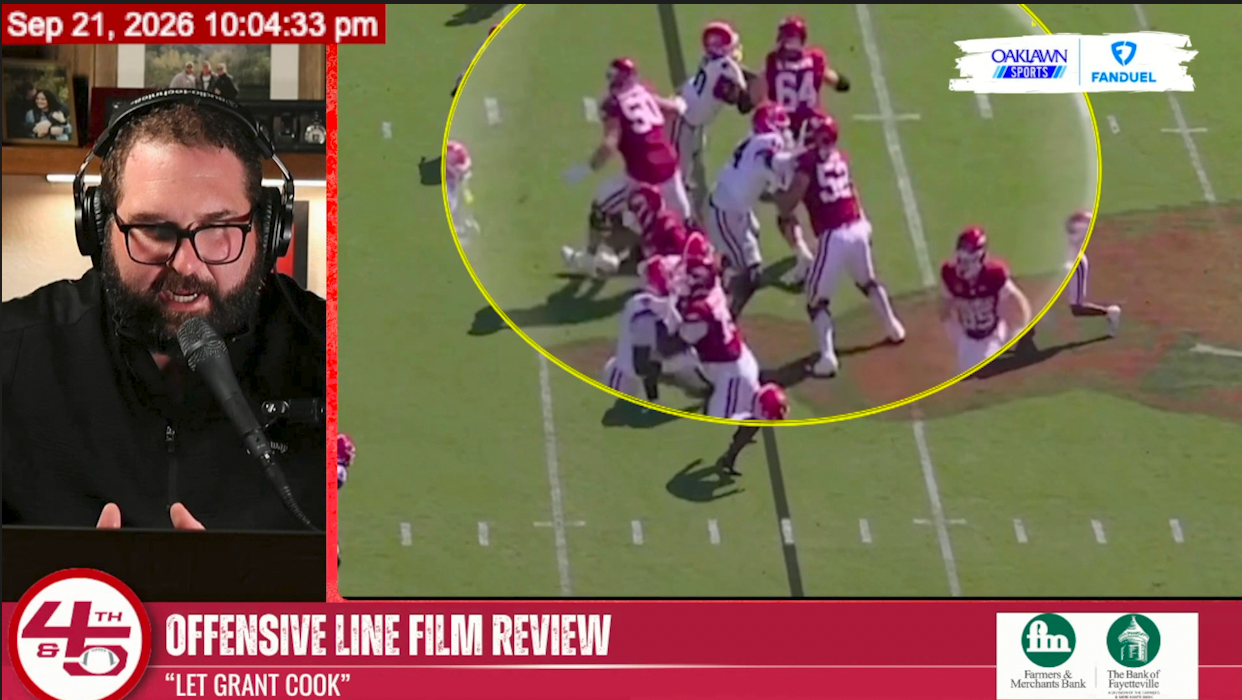
Three weeks into the season, Arkansas' running game has produced the same picture on tape almost every snap. On the latest edition of Let Grant Cook, the former Razorback offensive lineman stopped guessing and started pointing at one repeating habit up front.
Three Weeks, One Result
The numbers from Saturday's 45-17 loss to Georgia in Fayetteville are blunt. Arkansas carried the ball 20 times for 17 yards, a total that includes three sacks for minus-28. No Razorback rusher reached 20 yards. Georgia rushed 42 times for 254 and held the ball for 35:40.
Cook has now watched three straight weeks of the same tape, and he said he spent the first two of them trying not to believe what he was seeing.
"It's three weeks and the same result," Cook said. "It really looks like that we just don't have that aggressiveness up front."
That is where his fork in the road shows up, and he has not picked a side.
"Is this what they're being coached to do?" Cook said. "Is this just the type of player that we have?"
The Pin And Shuffle
Cook's description of the habit is the whole segment in one sentence.
"When we're coming off the ball, it almost looks like we're just putting our hands on people and then scooting our butt over to where the hole's going to be," he said.
Hands land. Feet stop. The lineman turns his hips and tries to wall the defender off instead of driving him backward. To Cook, that is not a block, it is a placement.
"That's a defensive lineman's dream," he said, pausing on a clip where a Georgia lineman sat square in the gap with his hands inside.
Williams framed what the defense gets out of it. If the lineman has not moved the man, the defender can play two gaps and wait for the back to declare.
Cook's fix is not complicated, and he walked through it with his hands on the screen. He wants the two blockers on a double team joined at the hip, pads under the defender, feet running north and south.
"I want those two hips to be together," he said. "You should see two butts almost like one big wide one."
The payoff, he said, is clarity for the ball carrier. A back who sees a wall knows where to put his shoulders. A back who sees a pile of bodies at the line of scrimmage has to guess, and then ram it.
Williams said the same thing shows up on the backside, where he counted a little shuffle step and then dead feet. Cook, watching one clip where the ball was clearly going outside, wondered aloud why the two backside blockers were not simply doubling the man in front of them and working up.
"I just don't get the scheme here," Cook said.
Watch: the full 4th & Five breakdown.
He Would Rather See A Whiff
Cook's strongest point came on a still frame where he drew a line across the original line of scrimmage. Five Razorbacks were engaged. Not one defender had been moved off that line.
Williams said it looks like the lineman believes he has won the rep simply because his body is between the defender and the hole. Cook is not sure the player is wrong to think it.
"I don't see that as a win, but I think maybe he's being coached that that's a win," Cook said.
He gave the group credit for one thing. Arkansas is accounting for bodies, or as he put it, covering up color. Every defender is getting blocked by somebody. The displacement is what is missing.
His reasoning is that the habit compounds. A team that pins and shuffles on first down in the middle of the field cannot suddenly find low pads and rolling hips on third and one, or on the goal line.
A Film Lesson From 2010
To show what he means by reestablishing the line of scrimmage, Cook pulled up Arkansas at LSU from the 2010 season, a closing drive the hosts remember running without throwing a single pass. The point was technique, not nostalgia.
The clips feature Williams at tight end and DeMarcus Love at tackle working a combination block, removing the end and then climbing. Cook froze it at the finish.
"Where's the line of scrimmage?" he said, noting the defensive end had been driven roughly seven yards downfield before he quit.
Cook explained why the linebacker never became a problem on that rep. Once the end is blocked back to linebacker depth, the linebacker cannot get to the ball without running through his own teammate.
Williams said the repetition is what made it work, and he did not arrive at Arkansas with it.
"I was not a blocker coming into college at all," Williams said. "I wanted to catch the ball."
What changed, he said, was learning to read the defense from motion and understanding how long to stay on a combination before climbing, because leaving early kills the play before it starts.
The Play Caller's Dilemma
The run game is not the only place the issue surfaces. Williams said three straight weeks of tape show Arkansas' linemen struggling to block in space, which puts the screen game squarely in the conversation.
He was careful to separate the call from the result. On several of those snaps, he said, the design was right. The defensive line ran itself upfield, the linemen released clean and the numbers were there at the second level.
But he also said the staff has to account for what its personnel can actually execute.
"If I don't have the guys that can get it done, now it becomes a bad play call," Williams said.
Cook's answer was a poker line.
"You got to play the cards you're dealt," he said. "You got to put them in positions you feel like they can be successful in."
Where The Hope Is
Cook did find something to build on, and it is not a small thing.
"Here's where I do think that we have a little bit of a glimmer of hope is in straight up pass protection," he said.
Against heavy pressure, he said, the front and the quarterbacks have generally sorted out the blitz well enough to let routes develop down the field. KJ Jackson finished 20-of-27 for 212 yards and a touchdown against Georgia, AJ Hill took several drives, and Chris Marshall led the receivers with seven catches. Arkansas piled up 142 of its 300 total yards in the fourth quarter.
The trade-off is obvious. Cook said the Hogs came close to shelving the run early, and with 20 carries for 17 yards he understands the impulse.
"We can't not run the ball at least a smidge," he said.
What Comes Next
Cook did not land on a verdict, and neither did Williams. The honest version is that the tape shows a habit, not a cause, and the cause is either coaching, personnel, or some blend of both.
Williams said the track record is what makes it strange, and he wants a control group. Head coach Ryan Silverfield, offensive line coaches Marcus Johnson and Jeff Myers and much of the staff arrived from Memphis, so Williams suggested going back to last year's Memphis tape.
"Are we doing something different?" Williams said. "If so, then why?"
Cook said he would dig into it and try to put two and two together. Until then, his standard has not moved.
"I want to see hips together," Cook said. "Reestablishing the line of scrimmage. We're three weeks in and that's not what we're doing."
Arkansas is 1-2 with Tulsa next. The number to watch is not total rushing yards, it is where the pile ends up. If Razorback helmets start finishing in front of the original line of scrimmage, the rest of the run game has a chance to follow.