The Razorbacks' Quarterback Question Is Still Open After the Georgia Film
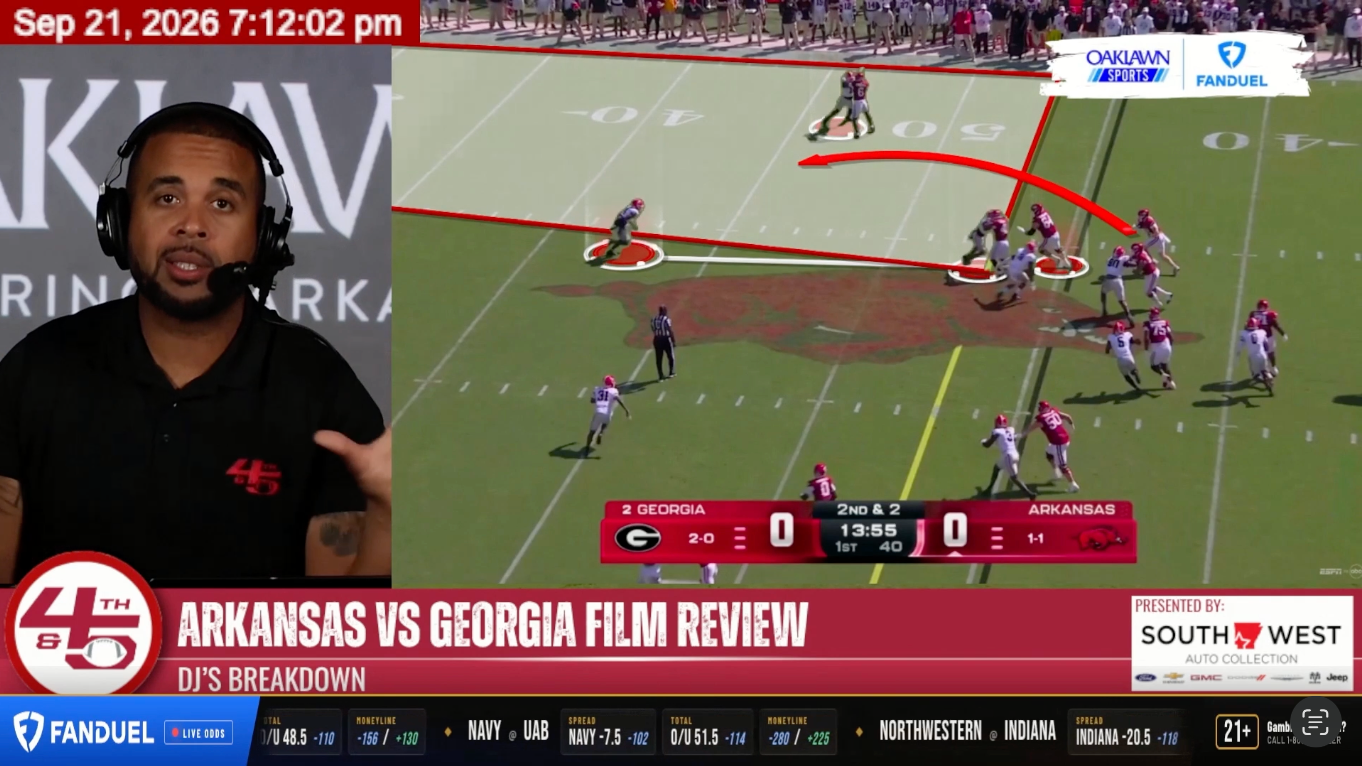
Arkansas walked into a game with the No. 2 team in the country and moved the football. That is not the problem. The problem, according to DJ Williams, is what the Razorbacks left on the field, and the fact that three games into Ryan Silverfield's first season nobody can say for certain who the quarterback is.
Williams spent an entire segment on the Georgia tape, clip by clip, and the phrase he kept landing on was not scheme and it was not talent.
It was opportunity.
A Touchdown Left On The Very First Snap
The opening play of the game was a completion to Chris Marshall for a first down. Fans cheered. Williams rewound it.
He pointed to a safety creeping down into the box before the snap, leaving one high safety in the middle of the field, and to a flat defender who never widened and instead sank underneath Marshall's route.
"I would, if I were a quarterback, this would intimidate me not to throw this ball," Williams said of the throwing window.
The bigger issue was what KJ Jackson never got to. Behind the rotating safety, Arkansas had a receiver running free on a busted coverage.
Williams anticipated the pushback. It was a completion. It was a first down. It was the first snap of the game against Georgia.
"I get it," he said. "But there are opportunities all over that field. And we missed one right there."
He also flagged a mechanical problem that shows up underneath all of it: the exchange. Low snaps to Cade Kitler's quarterbacks kept showing up on tape, and Williams argued that a quarterback cannot read a rotating safety while he is digging a football off the turf.
"We got to do better with the snap," he said.
Scheme Or Execution? The Tape Argues Both Ways
Tim Cramsey has taken the brunt of the public frustration through three games, and Williams went into the film expecting to pile on. He came out somewhere in the middle.
Play after play, he found calls he liked with blocks that never got made. A perfectly leveraged third-down protection where the checkdown was open and never thrown. A screen that Williams said was drawn up exactly right and died because Arkansas offensive linemen keep getting asked to block defensive backs in open grass.
"Perfect play call, poor execution," Williams said of one third-and-four break down.
He was not letting the call sheet off completely, though. Two snaps genuinely bothered him.
The first was a third and four with nothing attacking the middle of the field, the exact area Williams has argued for two straight weeks is where this offense makes its money. The second was the fourth-and-four that followed, an isolation route for Monty Harrison against man coverage.
"I love him. I think he's a great competitor," Williams said. "I don't know if he's my one-on-one guy, though."
His view was that a fourth-down call against Georgia is game planned days in advance, and that the ball should have been headed toward Marshall.
"Questionable play call, my humble opinion," he said.
There is also the RPO question. Williams said repeatedly that the body language on tape suggests the decision is being made before the snap rather than by the quarterback after it, which defeats the entire purpose.
"If we're going to run a true RPO, then let's run a true RPO," he said.
Watch: the full 4th & Five breakdown.
Tough Love For Ty Lockwood
No player showed up in the breakdown more than Ty Lockwood, and Williams was clear about why.
"He's slowly becoming one of my favorite players," he said. "And bad news for you, Ty. Now I'm going to pick on you a lot."
The clips stacked up. A hesitation as a lead blocker in the run game, where Williams wanted him to pick an aiming point and go instead of squaring up a defender in the hole. A tight end screen that was schemed and blocked well, where Lockwood was brought down by one defender with open field ahead.
That one hit a nerve. Williams, a former Arkansas and NFL tight end, said Chip Long and Paul Petrino held him to a standard he still carries.
He also did not like watching a cornerback get into Lockwood's chest on a perimeter block. "You being a big tight end, you have to impose your dominance on every single snap of the ball," Williams said.
At the same time, he defended Lockwood on a run where the tight end set an edge and the ball carrier cut back inside of it, and he was firm that Lockwood is not the problem.
"Ty Lockwood, I don't think's doing a bad job at all," Williams said. The spotlight, in his telling, is the compliment. Lockwood arrived in Fayetteville by way of Alabama and Boston College after signing as a four-star recruit ranked No. 139 in the ESPN300 and the No. 4 tight end in his class, and Williams clearly believes the ceiling is worth coaching hard toward.
KJ Jackson Leads. AJ Hill Is Right There.
The quarterback room is the headline, and Williams did not pretend otherwise.
Jackson was efficient against Georgia, completing 20 of 27 passes for 212 yards, and Williams praised several late-game reps where the junior worked through progressions behind a clean pocket and found Marshall.
He was tougher on the misses, particularly the third down where Arkansas had Georgia's blitz accounted for and a running back leveraged one-on-one against a linebacker across the hash. Williams believes Jackson was worried about the rush and never pulled the trigger, when a simple protection change would have solved it and protected the blind side of a left-handed passer.
Then there was AJ Hill, who entered the game and immediately produced a rep Williams could not stop replaying: a safety moved with the eyes, a snap of the shoulders to the outside route, a step up into the pocket, a throw delivered into the second window.
"Take a screenshot. That's how it's done," Williams said.
He also flagged Hill's long windup and the inconsistency that comes with it.
"I think we got two guys with all the potential," Williams said. "They're just a couple mental decisions away from getting it all figured out."
One Block Away, Over And Over
If there is a single sentence that summarizes the Georgia film, Williams said it out loud without meaning to make it a theme.
"One block away. How many times have I said that during this breakdown?"
The screens, the perimeter runs, the trick concept that flipped the field back to Hill. Williams thought each was well designed and each came apart at the same spot, with an offensive lineman trying to win in space. His fix is blunt: if the personnel cannot execute it by week three, stop calling it.
Pass protection, he said, is a different story. Georgia brought pressure repeatedly and Arkansas picked it up. "Pass protection, we're on to something," Williams said. The run game is the unsolved piece.
He also kept coming back to how much processing is still happening pre-snap, including a red zone breakdown before halftime where two receivers ran the same route with 10 seconds on the clock.
"You are not going to be a successful football team, especially on the offensive side of the ball, if you're still thinking before the snap," he said.
What It Means Heading Into Tulsa Week
Arkansas is 1-2 after the win over North Alabama and road losses at Utah and to Georgia, and the mood around the program reflects it. Williams came out of the tape somewhere other than the panic.
"I'm kind of letting off the gas a little bit on [Cramsey] after what I just saw," he said. "It's the execution."
There is one more caveat he offered on Marshall, who produced the signature catch of the day and drew stares from the Georgia sideline. "He is a special type of player," Williams said, before adding the warning: opponents are going to start bracketing him, and somebody else has to step up.
Grant Cook has the offensive line breakdown coming next, and Williams says Cook believes he has found the real reason the run game has stalled. That one is worth circling.
Tulsa comes to Fayetteville with Arkansas still sorting out a quarterback, a run game and a habit of leaving explosive plays on the grass. The talent is on the tape. The finishing is not, and that is the whole job this week.