What Can You Actually Learn From Fall Camp?
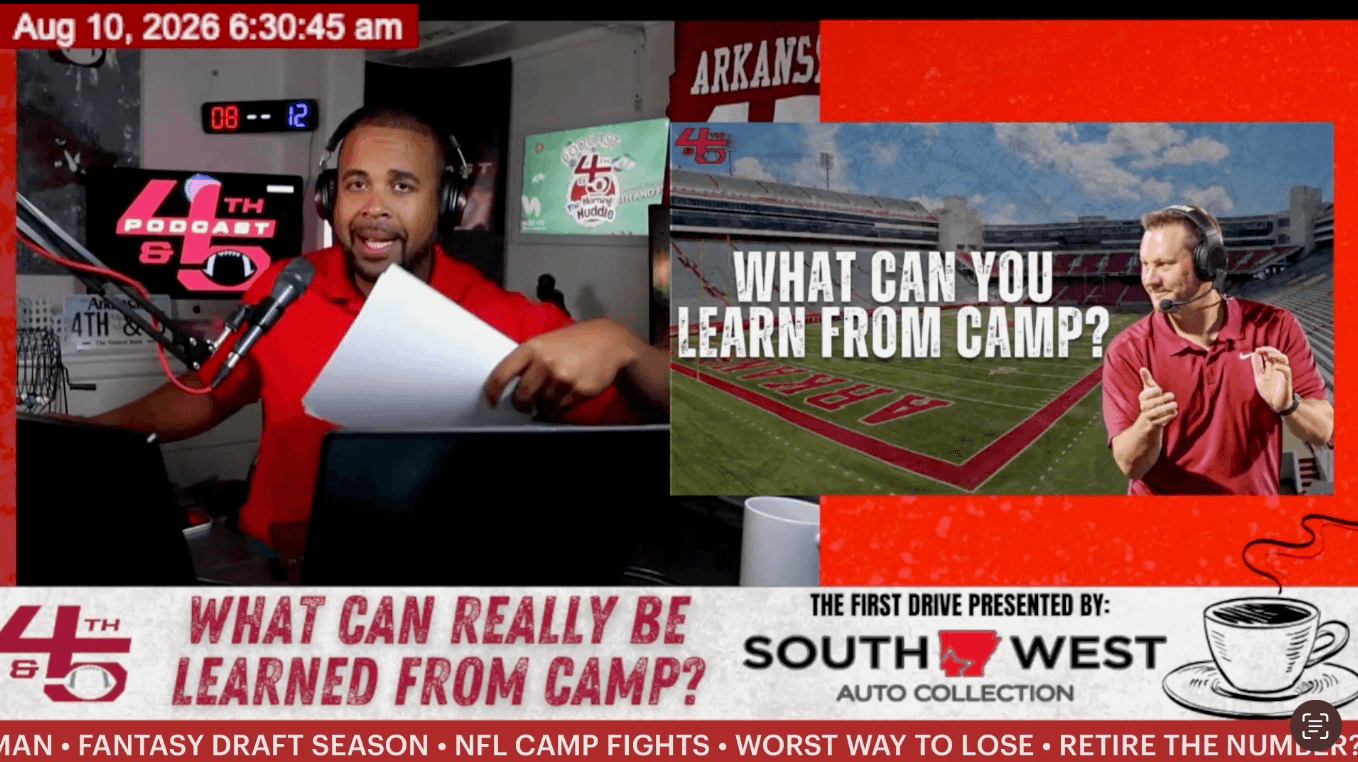
Fall camp is one of the most anticipated stretches of the college football calendar. Every practice produces reports. Every position battle gets analyzed. Every impressive throw, big run, or defensive stop can quickly become a storyline.
But how much can fans actually learn from the first few weeks of camp? That was the question DJ Williams and Grant Cook tackled on 4th & Five, and their biggest takeaway was simple: probably less than you think, at least this early.
Williams said there are certainly things worth paying attention to during fall camp, but many of the most important signs of a team's development aren't the ones fans see in practice clips or hear about in daily reports.
Questions about Arkansas' offensive line, secondary, running backs, quarterback competition, and overall depth chart will eventually be answered. But Williams cautioned that early practices don't provide enough evidence to confidently predict what the Razorbacks will look like when the season begins. Some of the most revealing developments, he said, may be happening away from the public eye.
Culture Tells You More Than Highlights
According to Williams, early camp can be particularly useful for evaluating the culture developing inside a program. Who's becoming a leader? Who commands respect when the coaches aren't around? Who arrives early, and who takes meetings, workouts, and preparation seriously?
Those things don't always translate into viral practice clips, but they reveal which players are beginning to take ownership of the team. Anybody can be energetic on the practice field, Williams said, but leadership inside the meeting rooms, the locker room, and the weight room tells coaches far more about the direction of a program.
Practice Only Tells Part of the Story
One of the biggest challenges of evaluating camp is that a practice can look very different once it's studied on film. Cook explained that he watches Arkansas as a fan first, then goes back to study the details. For an offensive lineman, that means grading every player on the line separately, often watching the same play several times.
A run might look perfectly blocked live, but film review can expose missed assignments, poor technique, or individual mistakes hidden by the result of the play.
That same principle applies to camp. A quarterback may complete a big throw, a back may break a long run, a receiver may keep making plays, but without seeing the entire rep and every player's responsibility, it's hard to know exactly what happened. It's why coaches so often say the same thing after games: they need to watch the tape. Williams and Cook believe camp deserves the same patience.
Watch: DJ Williams and Grant Cook break down what camp really tells you.
The Quarterback Conversation
One of the early Arkansas storylines has centered on the quarterback position. Williams referenced reports that K.J. Jackson has separated himself, and acknowledged he believes Jackson is currently ahead and will ultimately be the starter, but he cautioned against treating early observations as conclusions.
Mechanics, timing, release speed, ball placement, and command of the offense are all legitimate evaluation points. But there's one enormous variable camp can't fully recreate: game speed.
Williams recalled it firsthand from his NFL career in Jacksonville. Former first-round pick Blaine Gabbert looked exceptional in practice, the arm talent, the accuracy, threading passes into tight windows. Then game day arrived, and the quarterback on Sundays didn't always resemble the one dominating practice. It became one of the clearest examples of why practice reps don't automatically translate to Saturdays.
The "Practice Star" Problem
Arkansas fans have seen this before, players generating major offseason buzz on athleticism and practice reps, only for the results to look different once the season starts. Williams pointed to Miguel Mitchell as a current name drawing positive reviews: the tools are there, the speed is there, he looks the part. The question is whether it consistently shows up on game film. Williams said he hopes the reports prove correct, but after hearing similar praise before, he wants to see it when the games count.
That distinction runs across the roster:
- A receiver torching Arkansas DBs might be a future star, or the secondary might be struggling.
- A defensive lineman living in the backfield might be ready to break out, or the O-line might have problems.
Until a team faces outside competition, those possibilities are hard to separate.
The Real Test Comes Against Somebody Else
Perhaps the biggest limitation of camp is simple: Arkansas is practicing against Arkansas. Players learn their teammates' tendencies and techniques, and nobody truly knows how those reps compare to the rest of college football. Looking great against your own roster doesn't tell you what happens when the opponent is Georgia, Texas, or another high-level SEC team.
Experienced coaches can recognize some of those differences before the season. But for fans and media working with limited practice access, certainty should be hard to find.
So What Can You Learn?
Fall camp isn't meaningless. You can see which players are separating themselves, watch leadership develop, evaluate mechanics, conditioning, and effort, and start to see which players the coaches trust. What you probably can't determine yet is how all of it translates when the stadium is full, the opponent is unfamiliar, and the speed of the game changes.
For Williams and Cook, that's why patience matters. Fall camp gives clues. Film gives context. But Saturdays ultimately give the answers.