KJ Jackson Won Arkansas' QB Job in the Situations, Not the Highlights
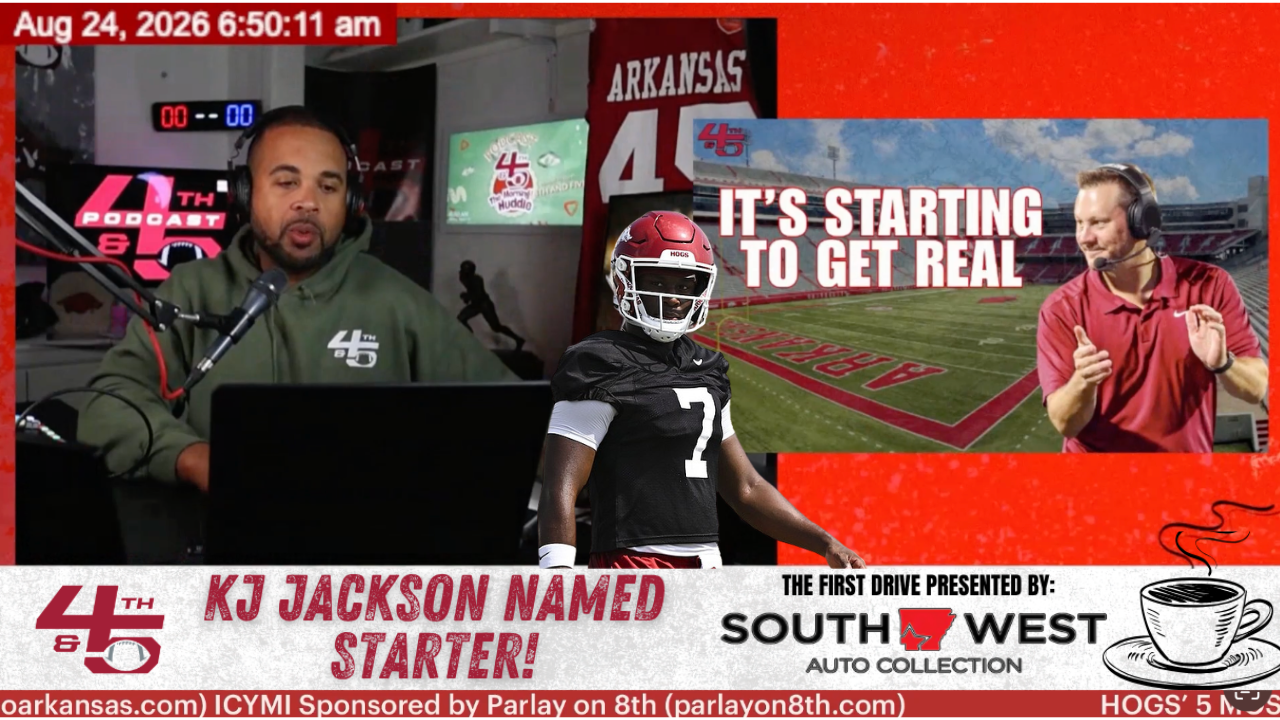
Arkansas has a starting quarterback, and how KJ Jackson won the job says as much about Ryan Silverfield's first fall camp as it does about Jackson himself. This was not a highlight reel decision. It was a decision made in fourth and one, with the play clock running down and the secondary moving.
Silverfield announced Jackson as QB1 following Saturday night's scrimmage, ending a competition the staff had hinted might run into the week of the opener.
"Obviously we just made the announcement that KJ will be our starting quarterback," Silverfield said. "Excited about him and his role as QB1 with the future of our program. He's done an excellent job. So has AJ Hill and all of our quarterbacks leading up to today in that decision."
Silverfield was direct about what the call was and was not. "It wasn't an easy decision, but a very confident one we made as a staff," he said. "And it wasn't because of lack of talent by the others. It was a great mix of guys competing for that starting role."
The Job Was Decided in the Situations
Offensive coordinator Tim Cramsey was the one who delivered the news to the quarterbacks. DJ Williams pointed out that, per the rest of the press conference, Cramsey informed both Jackson and Hill before Silverfield spoke to them about the role.
The reason given was situational football.
"What were you like in fourth and one, time running down on the clock, play clock's running low, motion in the secondary," Williams said. "You have these situational football moments where you have to think instantly and make a decision and make sure you get your team into the right play, or at least not in a bad play."
According to Williams, that is where the gap opened. "It seemed like, based off what I heard, that's where KJ was starting to create some separation, enough for them to go ahead and say this is our guy moving forward."
Grant Cook said that tracks with how the competition always figured to break.
"From an athletic standpoint and the physicality standpoint, those two guys are probably pretty evenly matched," Cook said. "And so it was going to come down to the mental battle of who's picking this up and who's rocking and rolling."
Cook noted Hill had the head start, having already spent a year in the building. That makes Jackson's climb the encouraging part.
"He's learned this entire offense right from when they got here in the spring and has applied it through the summer, and they feel comfortable with, okay, this guy's going to put us in the right positions," Cook said. "He's going to make the right call for an offense that is super decision based."
What Happens Next With AJ Hill
Williams did not pretend the news landed softly on the other side of the room. Silverfield said the quarterbacks handled it well, and Jackson and Hill talked it through themselves, but Williams framed the reality of any competition.
"You got a decision to make, AJ," Williams said. "Be pissed and in your feelings, or be ready when your name is called. And the thing about college football, you're always going to get an opportunity."
Cook said the staff will be evaluating both responses. "One handling success, one handling disappointment," he said, adding that teams who cannot manage the relief of a settled job often take a step backward.
Chemistry Beats Rotating Ones and Twos
The practical benefit of naming a starter now, Williams said, shows up in the receiver room. He pointed back to an earlier camp press conference from receivers coach Larry Smith, where the identity of the quarterback was the obvious elephant in the room.
"As a pass catcher, I'm telling you, it's different. The ball comes out different," Williams said. "So this will allow them now in practice to stop going back and forth between ones and twos, ones and twos, who's running with the ones, who's running with the twos, and having your guys start building chemistry."
Watch: the full 4th & Five breakdown.
Three Years, One Helmet, One Phone Call
Josh Throne wanted the loyalty piece on the record, because the path Jackson took is close to extinct.
Jackson arrived when Dan Enos was running the offense. He stayed through the Bobby Petrino interim stretch. He stayed through the coordinator uncertainty, stayed while Taylen Green took the snaps, and stayed again when Silverfield and an entirely new staff walked in.
"He had all these opportunities to transfer," Throne said. "There are not a lot of kids who have that type of loyalty and dedication to the university and to the hog on their helmet."
Jackson said his first call after being named the starter went to his parents. Williams said that detail hit him personally.
Three years ago on a road trip to Missouri, Williams said, Jackson's parents introduced themselves at a restaurant and told him they watched the show.
"They said, hey, keep an eye on our son," Williams said. "I know he's not getting a lot of playing time right now, but he wants to be here and he works hard. And so that was three years in the making. You have to love a guy that stuck it out."
The Honest Expectation for Week 1
Throne was careful not to turn the announcement into a projection. His read is grounded, and it starts up front.
"Now really the question mark for me is what's this offensive line going to look like," Throne said. "He's still a first year quarterback. We're still going to need to give him short down and distance on third down so that we can make sure that we're not putting him in situations like Taylen Green was a lot of the time. We're going to need a dominant run game."
If the run game and the line hold, Throne said, the situational instincts that won Jackson the job become an asset rather than a test.
Silverfield has said the Hogs are solidified on the offensive line, with the same five working together since spring. Whether that holds against live opponents is the part nobody in camp can answer.
Cut Wires, Missing Helmets and a Mock Game
The scrimmage that closed the competition ran 104 plays inside Reynolds Razorback Stadium with a 9:15 kickoff, deliberately built to simulate the Sept. 12 night trip to Utah and to get the team working under the new lights.
What comes next is more revealing about how Silverfield operates.
"This next Saturday coming up, we're going to do what we call a mock game," Silverfield said. "It's not a scrimmage. It's a true 60 percent pace jog through as many situations as I can think of. We've practiced taking a safety. We practice victory. We practice backed up."
Then he listed the curveballs he plans to throw.
"I'm going to do things like, guess what, I'm going to cut the wire to the headphones," Silverfield said. "Now all of a sudden Ron Roberts, in the middle of a play call, it goes down. Who's responsible for that? I'm going to steal somebody's helmet. All of a sudden this guy goes down with a shoestring. Who's the backup guy with kickoff? Because that's real life football."
Williams said that approach mirrors what he saw with Bill Belichick in New England, where team meetings opened with clips of rare situations and the rules that govern them.
"There's nothing worse in a crunch time situation than when something goes wrong and you have somebody that is in control that loses their cool," Williams said. "That's a professional approach. A coach that is being prepared for everything."
Cook called it the cliche that actually matters. "Control the controllables," he said, recalling the special teams tile the Hogs used under Petrino with 11 spots on it, so every player knew exactly where to be when a quick change hit.
"It's something that you don't think about until it happens and you're like, golly, why didn't we think about practicing this," Cook said.
Throne connected it to a specific Arkansas pattern. "There's been an entire timeout awareness problem at Arkansas," he said. "So in my opinion, I think that this type of stuff is really important."
Williams recalled a game he believed was Memphis where the Hogs burned a timeout coming out of a television timeout with the wrong number of players on the field, and needed that timeout later.
The Jack Spot Comes With a Public Challenge
Quarterback was not the only position taking shape. Asked whether the Jack could rotate week to week based on opponent, Silverfield said Sutton Smith has essentially separated himself, then delivered a challenge on the record.
"A guy like Charlie Collins, who I love and has done some really good things, until Charlie Collins puts that weight on, and I've challenged him and I'm doing so right now publicly, it's going to be hard for him to hold up versus a team that's going to line up with 340 pound offensive tackles over him every play," Silverfield said.
Collins is listed at 6-5, 240, and he led the first fall scrimmage with two sacks from that spot. The message, as Williams read it, is that Silverfield's requests are not suggestions.
"I say put on more weight, put on more weight, or we're going to find somebody who's going to do what we ask them," Williams said, framing the coach's stance. "And I think that's going to be the situation for every position on the football field."
Williams, who played tight end at Arkansas around 241 pounds, said the concern is real from the other side of the line of scrimmage. "If I saw Charlie Collins, I was like, oh, my day is going to be nice," he said. "Your only advantage is if you're just too big for me."
He added the flip side. "If you put on 10, 15, we don't just want him to do that because we think it looks cool. We know how much it will help him perform," Williams said. "He would be a monster because he's athletic, he's explosive."
What to Watch
Monday was an off day, and from here Arkansas moves into game planning for North Alabama and a 3:30 p.m. kickoff. The mock game comes Saturday. Then it is Utah under the lights on Sept. 12 and Georgia in the SEC opener a week later.
Jackson gets the reps, the receivers get the chemistry, and the offensive line gets its first real answer against somebody wearing a different color.
Williams kept the ceiling honest on the way out. "We can be excited, we can be optimistic, but at the end of the day, you got to perform on Saturdays," he said. "I don't care how many press conferences we listen to or clips we see from practice. It all has to work when you get out on the field."