Who Starts at Wide Receiver for Arkansas? The Razorbacks May Have Too Many Options
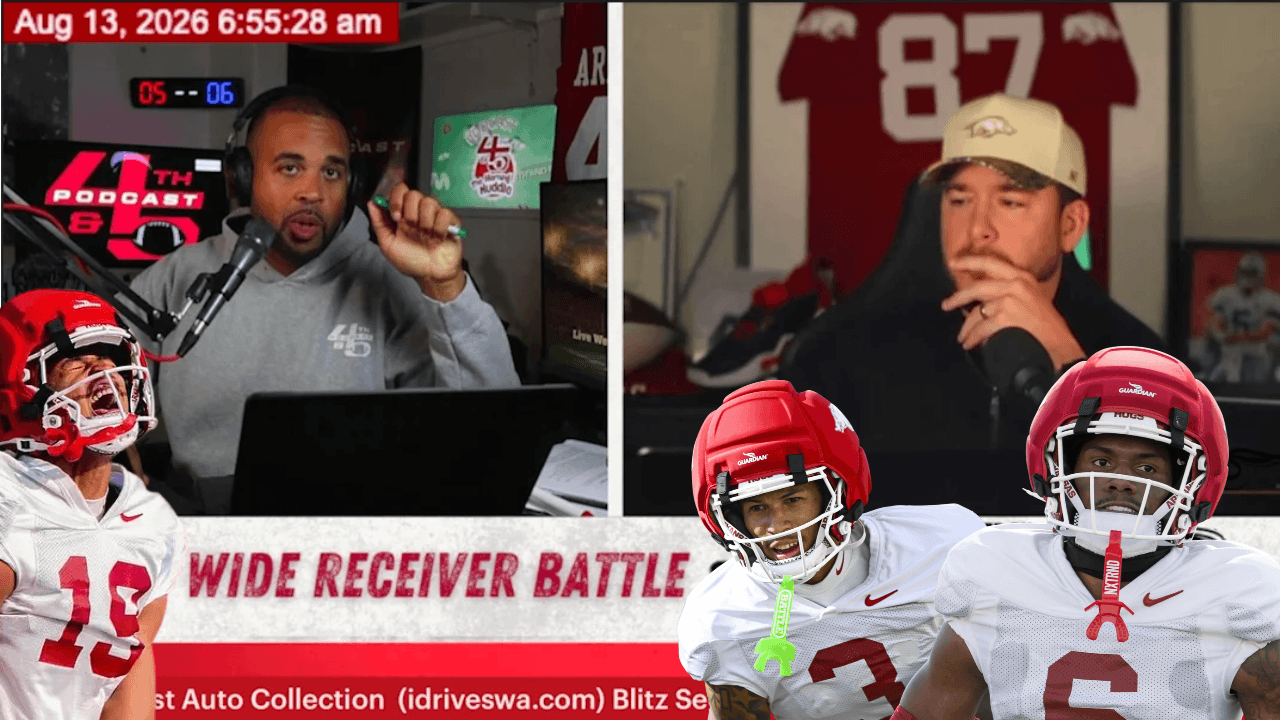
For all the questions surrounding Arkansas football heading into the 2026 season, wide receiver is becoming one of the most interesting. Not because the Razorbacks don't have answers. They may have too many.
Chris Marshall appears to be the closest thing Arkansas has to a clear-cut starter, but after that, projecting the Razorbacks' top three receivers becomes considerably more difficult.
Antonio Jordan is generating breakout buzz. Courtney Crutchfield continues to develop. Jamari Hawkins brings experience in the offense. CJ Brown offers versatility. Ismael Cisse is battling for work in the slot. Jelani Watkins brings elite speed. Donovan Faupel is another transfer drawing attention. Then there's Monte Harrison, a 6-foot-3, 222-pound physical presence who gives Arkansas yet another intriguing option.
During a 4th & Five discussion, DJ Williams, Grant Cook and Josh Throne tried to answer what sounds like a simple question: if Arkansas had to start three wide receivers tomorrow, who would they be? It wasn't easy.
Watch: the full 4th & Five breakdown.
Chris Marshall Appears to Be the Safest Bet
There wasn't much debate surrounding Chris Marshall. The 6-foot-3, 213-pound senior transfer from Boise State brings the size and physical ability Arkansas wants on the outside, and he has consistently been discussed as one of the leaders of the receiving corps.
Grant Cook called Marshall "special" and included him immediately when projecting Arkansas' starting three. Williams did the same. If we're attempting to pencil in Arkansas' opening-day receiving corps, Marshall appears to be the easiest name to write down. The real debate begins with the other two spots.
Is Antonio Jordan Becoming Too Good to Keep Off the Field?
Josh Throne made perhaps the strongest argument for Antonio Jordan.
It's easy to understand why. Jordan has the type of physical traits coaches can't manufacture. Williams has been particularly impressed with his catch radius, pointing to the receiver's ability to climb the ladder and make plays on footballs outside the normal throwing window.
Jordan entered Arkansas with plenty of expectations but dealt with injuries that prevented him from fully establishing himself. Now the conversation is changing. Instead of talking primarily about potential, Arkansas is beginning to hear about a player who could be ready to turn that potential into production.
Throne believes Arkansas should embrace it. "His physical presence is insane," he said. "You can't coach that." The problem? Jordan isn't competing against an empty depth chart.
Courtney Crutchfield Is Making His Own Push
Courtney Crutchfield isn't making the decision any easier. Williams believes Crutchfield has undergone a significant transformation over the past year and described a receiver whose athleticism immediately stands out.
There is an ease to the way Crutchfield moves. Some receivers look like they're working to run. Others seem to float. Williams puts Crutchfield in the second category. Combine that athletic ability with reliable hands and continued development, and the former Pine Bluff standout could force Arkansas to find snaps for him.
That means one outside receiver position could feature a legitimate battle involving Jordan, Crutchfield and potentially CJ Brown. For Arkansas, that's a good problem. For anyone trying to predict the starting lineup, it's a nightmare.
Jamari Hawkins Has One Advantage Nobody Else Can Replicate
Then there's Jamari Hawkins. The Memphis transfer has something particularly valuable in a new offense: familiarity. Hawkins played for Ryan Silverfield at Memphis, and Cook believes his understanding of the system could ultimately be what separates him.
Cook's projected starting three consisted of Marshall, CJ Brown and Hawkins. His reasoning wasn't based simply on athletic ability. It was how quickly Hawkins can play because he already understands what Arkansas is trying to accomplish offensively.
Instead of approaching the line of scrimmage and processing every detail of a new system, Hawkins can recognize the situation and react. The difference between thinking and reacting can be the difference between a receiver playing fast and looking a step behind.
Hawkins also provides another benefit. With so many receivers learning a new system, teammates can turn to a veteran who already understands the terminology and expectations. Throne pointed out that younger or less experienced players can look over and ask Hawkins what they're supposed to do. Those things don't appear on a stat sheet, but they can make Hawkins extremely difficult to remove from the lineup.
Don't Forget About Ismael Cisse
Hawkins isn't alone in the slot competition. Williams believes Ismael Cisse is in a legitimate battle with Hawkins, one that could continue throughout camp and potentially into the season.
Cisse, a Stanford transfer, gives Arkansas another experienced option in a receiving corps filled with different skill sets. If Hawkins' knowledge of the system gives him an early advantage, Cisse still has an opportunity to earn snaps and keep the competition alive.
And that becomes an important distinction with this receiving corps. Naming three starters may not tell us much about how Arkansas actually distributes playing time. The Razorbacks could rotate receivers heavily depending on formation, opponent and situation.
CJ Brown Might Be Arkansas' Most Versatile Receiver
CJ Brown makes the projection even more complicated because he may not need to own one specific position. Williams believes Brown can essentially play all three receiver spots.
That versatility is enormously valuable. Injuries happen. Formations change. Matchups dictate personnel. Having a receiver who can move across the formation allows offensive coordinator Tim Cramsey to adjust without completely changing personnel.
It's also one reason both Williams and Cook ultimately included Brown among their projected starting three. He may not have to dominate one specific position battle. He can contribute everywhere.
And Arkansas Still Hasn't Fully Unleashed Jelani Watkins
Then there is perhaps the biggest wildcard in the room: Jelani Watkins. Watkins brings legitimate track speed to Arkansas and gives the Razorbacks a weapon capable of changing the geometry of a defense.
Speed like that has value even when the football isn't thrown his direction. If Watkins proves he can consistently threaten defenses vertically, safeties have to respect it. Corners have to respect it. And that can create space underneath for everyone else.
The question is exactly how Arkansas intends to use him. Williams acknowledged that Watkins is one of the players he's most curious to see because his speed gives the offense something unique. Even if Watkins isn't technically one of Arkansas' first three receivers, it's difficult to imagine the Razorbacks ignoring that kind of weapon.
Donovan Faupel Adds Another Name to the Competition
Just when the receiver conversation seems crowded enough, Donovan Faupel enters the picture. The New Mexico State transfer is listed at 6-foot-1 and 201 pounds and has also generated attention during camp.
Faupel isn't receiving the same level of preseason discussion as Marshall or Jordan, but his presence illustrates the bigger point: Arkansas has options. Williams started counting the legitimate possibilities during the discussion and quickly reached seven players who could factor into the rotation. That is considerably different from simply having seven receivers on the roster.
What About Monte Harrison?
Monte Harrison may be the most unique player in the entire conversation. At 6-foot-3 and 222 pounds, Harrison doesn't look like a traditional receiver. Williams jokingly offered another solution: come join the tight ends.
Harrison's combination of size, strength and athleticism makes the idea fascinating, even if he remains officially listed as a wide receiver. Put that type of body against a smaller defensive back and Arkansas potentially has a major size advantage. Move him inside and ask a linebacker to cover him, and the athletic advantage could swing in the other direction. His role remains something to watch, but his presence gives Arkansas yet another physically different option.
So Who Are the Three?
Eventually, the 4th & Five crew had to stop hedging and make a choice. Cook went with Chris Marshall, CJ Brown and Jamari Hawkins. Williams eventually landed in essentially the same place. Throne wasn't ready to leave Antonio Jordan out.
And that's what makes this position battle so interesting. Marshall appears established. After him, there is a legitimate argument for several combinations. Hawkins brings experience and knowledge of the offense. Brown brings versatility. Jordan may have one of the highest physical ceilings in the room. Crutchfield continues to emerge. Cisse is battling for the slot. Watkins has game-changing speed. Faupel adds another experienced transfer. Harrison brings a completely different physical profile.
The eventual answer may be that Arkansas doesn't really have three starting receivers. It has a rotation.
Potential Doesn't Matter Until Saturdays
There is one important caution surrounding all the excitement. Arkansas' receiving corps hasn't proven anything yet. Williams referenced outside skepticism about the group and acknowledged why it exists. What has this group actually done? That's a fair question.
There isn't an established 1,000-yard SEC receiver sitting at the top of the depth chart. Much of the optimism surrounding Arkansas' receiving corps is based on projection, development, transfers and what players have shown during practices. But Williams believes anyone who has actually seen the group work in person would come away with a different impression.
The talent is there. The size is there. The speed is there. The competition certainly appears to be there. Now Arkansas needs the production.
If players such as Jordan and Crutchfield make the developmental jumps the Razorbacks believe they're capable of making, and veterans such as Marshall, Hawkins and Brown provide consistency, wide receiver could go from one of Arkansas' biggest preseason questions to one of its deepest position groups. The hardest part may simply be deciding who gets the football. And if that's the biggest problem Arkansas has at wide receiver in 2026, the Razorbacks will gladly take it.