What Arkansas Should Know By Now: Personnel First, Names Later
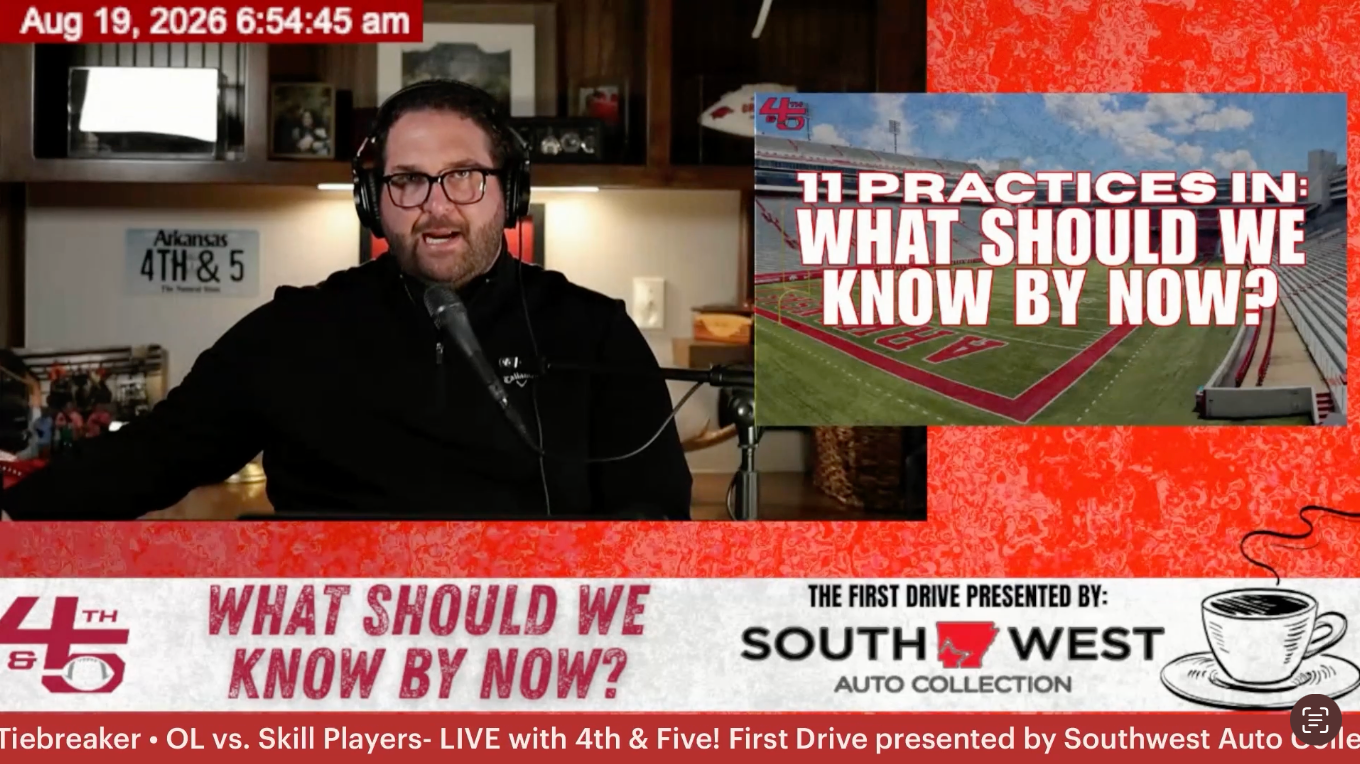
Eleven practices into fall camp, the loudest question around Arkansas is still the quarterback. On 4th & Five, DJ Williams made the case that it is not the most important one.
The Razorbacks are working through camp with a brand new coaching staff and a heavily overhauled roster, with a full spring already behind them. No starter has been announced. No depth chart has been released.
And according to Williams, the thing a first-year staff should be learning right now has almost nothing to do with name plates.
"What I think we should know by now is what we're deficient in, where our weak links are, and now the coaches need to kind of adjust around that," Williams said.
The Nabers Point: There Is Always A Weak Link Somewhere
Williams framed it with something he heard from Malik Nabers, the former LSU receiver who was drafted sixth overall by the New York Giants in 2024 and who left Baton Rouge with a school-record 3,003 receiving yards.
Nabers was asked about the jump from college to the NFL.
"In college, there was always a guy out there on the defensive side of the ball that they could pick on," Williams said, relaying the answer. "They would see through tape and film, and when the game started, they realized there's usually a weak link out there somewhere. And he said they were able to put him in a position to attack it."
The pros are different, Williams said, and Nabers explained why with a jersey number.
"He said he knew it was special in the NFL because when you saw a DB out there with a number like 37, you would think, oh, that guy's trash," Williams said. "He said, no, 37's a dog. There are no weak links."
College football is not built that way. Which means every staff, including this one, is walking into camp with soft spots on the roster and an obligation to find them before an opponent does.
Watch: the full 4th & Five breakdown.
Hudson Clark, And What A Great Coordinator Actually Does
Williams reached back for a teaching example, and it is one Arkansas fans know well.
Hudson Clark, a former walk-on defensive back, intercepted Ole Miss quarterback Matt Corral three times in Fayetteville on Oct. 17, 2020, becoming the seventh Razorback ever with three picks in a game. It remains one of the great individual afternoons in recent Arkansas history.
Williams' point is what the tape shows underneath it.
"A lot of that was in a zone type coverage and they were just laying it up," Williams said. "In zone, smart guy, instinctive, knew where to be, could use his brains to let him get to an angle. But in man-to-man coverage, trouble."
What frustrated him was the follow-up.
"I'm over here trying to figure out why the defensive coordinator has Hudson Clark on an island with no safety help over the top," Williams said. "How many times is that going to be exploited before something changes? As soon as they tried it, they should have went to something else."
Williams was clear that this is not a shot at anyone currently in the building. It is a standard.
"Sometimes coordinators say we don't have another option," he said. "These special coordinators, the ones that can change a team and defense and actually get them to the next level, I think they're good enough and savvy enough to build their defense in a way to help kind of cover some of those areas."
That, Williams said, is what he is hoping this new staff can bring to the table given the personnel on hand.
The Screen That Never Should Have Been Called
Williams took the same argument to the offensive side, and the example still bothers him.
Arkansas used to pull its right tackle out on wide receiver screens and ask him to block a defensive back in space. Josh Throne identified the coordinator behind that scheme as former Arkansas offensive coordinator Kendall Briles.
"You give it a couple opportunities to see if your guy is athletic enough to do it," Williams said. "I saw enough times on film he just can't get it done. On paper it looks great. If he gets the block it's a beautiful play. You don't have the personnel that can get that done. Don't call the play."
Then came the line that holds the whole segment together.
That is the standard Williams is applying to the new staff. Not whether the playbook is clever, but whether the playbook fits the twenty-two men who will actually run it.
Eleven Practices In, The Roles Should Be Taking Shape
Grant Cook agreed on the timeline, if not the emphasis.
"Inside the four walls of that building, that's where we need to be in camp," Cook said. "All right, here's our 22 guys we're about to go to war with, and here are the guys that we feel like are going to contribute at those positions that maybe there's some variance there."
Throne pointed to the backfield specifically. Sutton Smith, the all-purpose back who ran for 669 yards and seven touchdowns at Memphis in 2025 and landed on the Doak Walker Award preseason watch list, and Braylen Russell, the Benton native who returns for his junior season after 286 yards and five rushing touchdowns as a sophomore and who also made the Doak Walker watch list.
"We know Braylen Russell's going to be involved," Throne said. "How are those guys going to be involved? We need to start picking those things out and really starting to dive into specific game plans and things like that at practice number 11."
On the quarterback, Throne drew a line between what the public knows and what the staff knows.
"I know we don't know," he said. "But I do think the coaching staff's got a pretty good idea at this point who's going to roll out there. Whether they come out and say that or not, I know that's a little bit of a strategy as well, but someone has separated themselves to a certain degree."
The Defense Has Changed Its Tone
One shift has been audible from the outside. Early in camp, Arkansas defensive coaches were publicly blunt about a lack of intensity and slow get-off, holding nothing back in interviews.
Roughly two weeks later, the language coming out of those same interviews is different. Coaches have praised the group's competitiveness, its effort and its willingness to finish through plays.
That is not a scrimmage result, and it is not a depth chart. But it is a group responding to being called out, which is its own kind of information for a staff still learning who it has.
The Depth Chart Exists. You Just Cannot See It.
Williams is not expecting an announcement soon, and he had some fun with why.
"If you're ever able to sneak into the coach's room, they got this big board and the depth chart's already there," he said. "They just haven't released it yet. And you can see they got little Velcro name plates or magnetic ones that they'll move up and down."
His guess on when the rest of us see it: "It may be a minute."
The names will come. The more telling question is whether this staff has already figured out what its players cannot do, and has the honesty to stop asking them to do it.